
Believing in the Wood Fire: Why Watching a Fire Soothes
Why does a wood fire hold our attention without handing us a task? From Éluard to soft fascination and fireside talk, a look at what watching a fire does to the mind and the body.
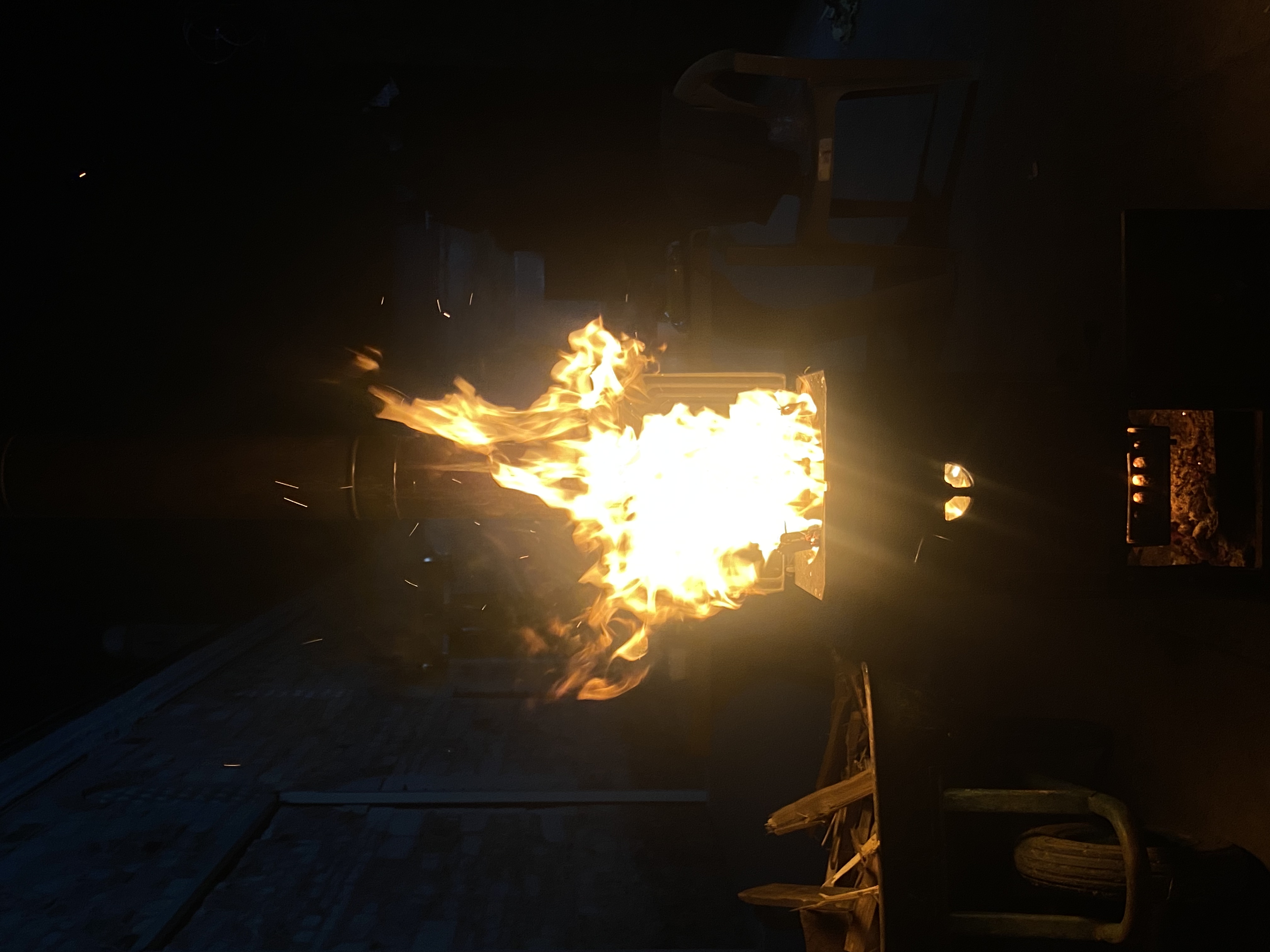
Let us begin with a poem
In the poem "Faire vivre", Paul Éluard writes: “They were a few who loved the forest / Who believed in the wood fire.” We could read those lines as poetry. What we are doing today is reading them as psychology and physiology. People will of course step out of the underbrush to ask who we think we are. I smile at them, and point them to the bibliography at the end.
But first, a little lingering on that word believe.
Nobody believes in the existence of a wood fire. This is not an ontological question. You are already a witness to it. It is there. It crackles, flicks out little sparks, rises, dies down, and if you put your hand too close it burns you in a way that leaves no room for scientific debate. The belief Éluard is talking about is less a conviction that something exists than a willingness to hand yourself over to the world that gets built around it.
Because fire is not merely burning wood. Sometimes a fire destroys a forest, and we drop whatever we are doing and go to save it. Sometimes we know it will burn in the middle of a circle, and we drop whatever we are doing and go to watch it. Fire is the sort of thing that makes you put the work down.
There is an etiquette to talking by a fire. You do not make eye contact with the person, or people, you are talking to, and if the smoke comes at you, you do not move. You wait. Move, and the smoke follows. You cannot outrun smoke.
We have made our jokes and dawdled long enough. On to the actual subject.
In Turkish, seyretmek means two things. One: to wander, to go. Two: to watch. In the second sense, watching is also a going. The mind sets off. When we watch a film we watch it with the mind, of course. But that watching has to stay coherent, because everything that can be watched has to sit inside a context. That may well be why series whose context can fairly be called absurd have lately found such an audience. Anything that can step outside the mind’s ordinary current gives a person a superior pleasure.
Also, everything we watch, even everything we do, expects a task of us. Watching a film, you have to follow the story. Reading a book, you have to tie the words together. Listening to music, you have to keep up with the rhythm or the lyric. Phones are ruder still. They want not only your attention but your finger. They expect you to scroll, to like, to reply, to move on to the next image. Sit there staring blankly at the screen and doing nothing, and the phone begins to doubt your humanity and asks, “Are you still there?”
A fire expects no task of you.
Turn your head and there is no event you have missed, no context, no moment you are obliged to go back and catch. One flame may have risen beautifully a moment ago. If you didn’t see it, you didn’t see it. It does not take offense. It does not ask for a response. One log has settled onto another, and you missed it. The fire does not mind. Sparks have jumped, and you were looking elsewhere. You look anyway. Fire wants attention. It does not assign a duty.
And since we cannot predict what shape a flame will take, which log will collapse and when, or when the next crack will come, we have to think about that unpredictability. It is not the unpredictability of footsteps behind you on a dark street. It offers trust more than threat. For the primitive side of the human mind, it offers trust absolutely. There is a fire. You will not freeze. The smoke keeps the insects off. You can feed yourself. What were we saying? Unpredictability.
The unpredictability of a wood fire — and you will have gathered that I mean the controlled kind — is like being asked, down at the station, “Mind if I ask you something?” Unpredictable, yes. No real chance of being a threat. For the fire to be soothing, though, a quiet contract has to be in force between you and it:
You will burn over there. I will sit over here.
In psychology there are studies showing that attention is held longer by stimuli that are neither too simple nor too complex. In research on the “Goldilocks effect,” infants’ attention drifted sooner both from images that were wholly predictable and from images too absurd or surprising to process. Attention stayed longer in the middle, where the mind could grasp the thing but not wholly solve it.
I am not about to stand up and say babies like fire, therefore we are all cave people. Science is not the sort of thing that makes a fire by knocking two stones together. The study in question was not even about fire. It does, though, give us a good way of thinking about why a fire can be watched for hours.
A fire is neither wholly repetitive nor wholly unruly. The mind cannot lose interest, because it cannot quite tell what comes next. It does not go on alert, because it knows that whatever happens will stay inside its own limits. Call it a controlled uncertainty.
Which brings your childhood back more clearly: light leaking in through a window, or the fire’s movement thrown from the stove onto the ceiling? Worth a thought.
Soft fascination
You may already have heard of this. I hadn’t, until I walked cheerfully into a wall while researching the subject. Soft fascination. In Turkish it can be rendered as yumuşak büyülenme, zahmetsiz dikkat, or yumuşak odaklanma: a soft enchantment, effortless attention, a soft focus.
According to Attention Restoration Theory, the attention we direct while awake is limited. Trying to understand a text, writing code, following one voice in a crowd, talking while constantly monitoring yourself: all of it is mental labor. Used that way for long enough, attention tires.
Certain natural sights oil the hinges of the gate. The movement of clouds, the come and go of waves, leaves shaking in the wind, and flames are stimuli of this kind. You do not have to make an effort to look at them. Looking at them does not occupy every resource the mind has. Watching a fire does not leave all of your attention hanging in empty space. A small part of it stays out there, on the flames. The rest is free to wander: toward a memory, a thought, a half-finished sentence, or whatever the person across from you is saying.
That is one reason talk in front of a fire can deepen. The fire does not pull the mind out of the conversation. The mind becomes, magnificently, in possession of a focus. It stops calculating what it ought to say, and says what actually needs saying.
A television, by contrast, seizes our attention outright. For the mind it is something like a candy apple. Colorful, flashy, moving. Mmm. But once it has all that attention, it leaves us no mental room. It wants us tracking the next scene, what is about to happen, the lines, the ending. Fire has no plot. Fire’s plot is us. It cannot be missed. Turn your head away and turn it back, and you have missed nothing.
A wood fire gives us a place where we can set our attention down, and are not obliged to pick it up again.
What the body does in front of a fire
In three separate experiments, the anthropologist Christopher Lynn looked at changes in blood pressure among 226 adults shown a silent fire, and a fire given with its crackle. The most consistent drop came when the image of the fire was presented together with its natural crackling. The effect was clearer across fifteen-minute viewings than across five-minute ones.
The interesting part is that the silent fire did not relax people nearly so consistently. So it is not quite right, or not quite enough, to pin the effect of fire on the visual movement of the flames alone. The crackle, the room tone, the expectation of warmth, and whatever we have already lived with fire are all part of the whole. The more senses we can reach the mind through, the more the effect is worth.
Oh, and in the experiment people were not talking by the fire. The researchers did not measure how intimate the talk was, how deep the subjects ran, or how far people opened up to one another.
The language of day, the language of night
One of the most striking studies of fireside talk belongs to the anthropologist Polly Wiessner. Among the Ju/’hoansi of southern Africa, Wiessner compared 174 daytime and nighttime conversations, and 68 translated transcripts.
Daytime talk ran to economic matters, jobs to be done, complaints, and the gossip that keeps social relations in order. Thinking about this, we have to remember that the reported-speech suffix -mış/-miş belongs only to our language. At night, around the fire, talk turned toward things that had happened, people far away, stories, cultural institutions, and the supernatural.
By day, people talked about how life is to be carried on. By night, about what life means.
Another important conclusion of Wiessner’s is that fireside stories are not merely entertainment. The stories keep people who are not there present in the mind. They recount past behavior, friendships, conflicts, and the rules of the community. Listeners imagine what other people thought and felt. Which is to say that besides the people physically at the fire, the people in the mind are there too.
The circle of a wood fire may be physically small and still hold quite a crowd around it in the mind.
Back to the poem!
Yes. We have to go back to the poem.
We know that “those who BELIEVE in the wood fire,” in Éluard’s line, is not an accident. Poets choose every word with care.
As I understand it, “those who believe in the wood fire” are not people who believe the fire has certain mystical powers. They are people who still believe that a few of us, sitting around the same center, can change something. The line is about what it means to gather. They believe people can talk without hurrying, that a conversation can happen without anyone working the room, that the dark does not have to be done away with.
The world is not wholly predictable. Neither is the person across from us. We cannot know which memory will open next, which sentence will silence us, which confession will be said while looking into the fire. But so long as the small circle around the fire holds, that uncertainty stops being a threat and builds a magnificent road toward talk in its purest form.
I am sure those few people Éluard speaks of would set a burnt finger on the last lines below, lighting the fire as they do.
You do not have to know every tree in order to love the forest.
Nor predict the next flame, in order to believe in the wood fire.
Sources
- Berlyne, D. E. (1970). “Novelty, Complexity, and Hedonic Value.” Perception & Psychophysics, 8, 279–286. https://doi.org/10.3758/BF03212593
- Gowlett, J. A. J. (2016). “The Discovery of Fire by Humans: A Long and Convoluted Process.” Philosophical Transactions of the Royal Society B, 371, 20150164. https://doi.org/10.1098/rstb.2015.0164
- Kaplan, S. (1995). “The Restorative Benefits of Nature: Toward an Integrative Framework.” Journal of Environmental Psychology, 15(3), 169–182. https://doi.org/10.1016/0272-4944(95)90001-2
- Kidd, C., Piantadosi, S. T., & Aslin, R. N. (2012). “The Goldilocks Effect: Human Infants Allocate Attention to Visual Sequences That Are Neither Too Simple Nor Too Complex.” PLOS ONE, 7(5), e36399. https://doi.org/10.1371/journal.pone.0036399
- Lynn, C. D. (2014). “Hearth and Campfire Influences on Arterial Blood Pressure: Defraying the Costs of the Social Brain through Fireside Relaxation.” Evolutionary Psychology, 12(5), 983–1003. https://doi.org/10.1177/147470491401200509
- Mehta, V., Zhu, R., & Cheema, A. (2017). “Can Lighting Influence Self-Disclosure?” Frontiers in Psychology, 8, 234. https://doi.org/10.3389/fpsyg.2017.00234
- Ohly, H., et al. (2016). “Attention Restoration Theory: A Systematic Review of the Attention Restoration Potential of Exposure to Natural Environments.” Journal of Toxicology and Environmental Health, Part B, 19(7), 305–343. https://doi.org/10.1080/10937404.2016.1196155
- Stevenson, M. P., Schilhab, T., & Bentsen, P. (2018). “Attention Restoration Theory II: A Systematic Review to Clarify Attention Processes Affected by Exposure to Natural Environments.” Journal of Toxicology and Environmental Health, Part B, 21, 227–268. https://doi.org/10.1080/10937404.2018.1505571
- Wiessner, P. W. (2014). “Embers of Society: Firelight Talk among the Ju/’hoansi Bushmen.” Proceedings of the National Academy of Sciences, 111(39), 14027–14035. https://doi.org/10.1073/pnas.1404212111