
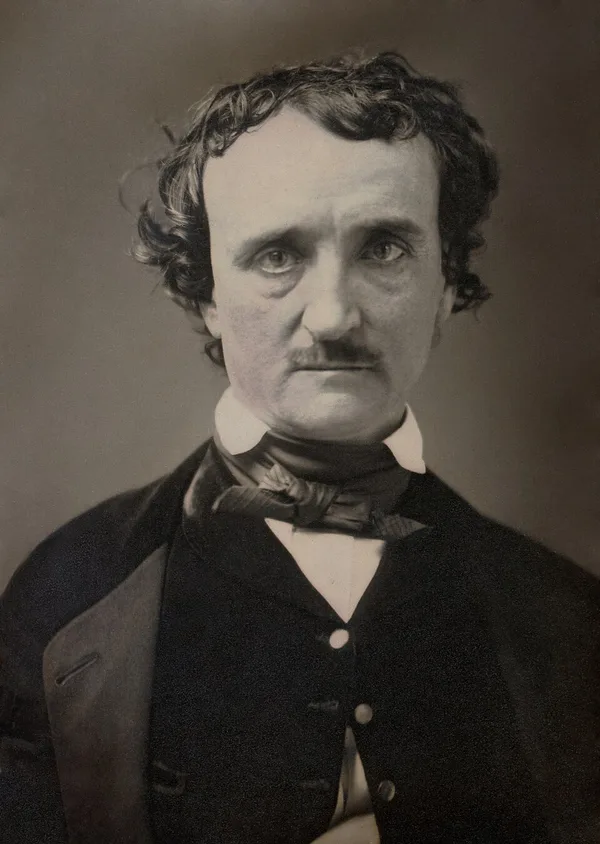
Edgar Allan Poe
Edgar Allan Poe
Edgar Allan Poe was born in Boston on January 19, 1809, the second child of a family of actors. His father abandoned the family in 1810, and his mother died of tuberculosis a year later. The orphaned Edgar was taken in by John Allan, a tobacco and cloth merchant in Richmond, Virginia, and his wife Frances. Although the couple never formally adopted him, they gave him the name "Edgar Allan Poe".
The Allans travelled to Great Britain in 1815, where Poe attended school in Scotland and then boarding schools in London. After returning to Virginia in 1820 he continued his education in Richmond. In 1826 he enrolled at the University of Virginia, but because John Allan did not send him enough money he ran up gambling debts and had to leave after a year. In the same period his fiancée, Sarah Elmira Royster, married another man.
Having moved to Boston in 1827 and struggling to support himself, Poe enlisted in the army under the name "Edgar A. Perry". That same year he published his first book, "Tamerlane and Other Poems", signed only "a Bostonian". After two years of service, a temporary reconciliation with John Allan followed the death of Frances Allan in 1829, and Poe entered the West Point military academy. Because of Allan's remarriage and their continuing quarrels, however, Poe deliberately committed breaches of discipline and was dismissed in 1831.
Returning to Baltimore, Poe lived with his aunt Maria Clemm and her family. In 1831 he published his third book, "Poems". In 1833 his story "MS. Found in a Bottle" won a prize and attracted the attention of John P. Kennedy, a wealthy Baltimorean, with whose help he became assistant editor of the Southern Literary Messenger in Richmond in 1835. In this period he obtained permission to marry his 13-year-old cousin Virginia Clemm; the marriage took place on May 16, 1836.
While at the Southern Literary Messenger, Poe raised its circulation from about 700 to 3,500. His only novel, "The Narrative of Arthur Gordon Pym of Nantucket", appeared in 1838. In 1839 he became assistant editor of Burton's Gentleman's Magazine and later of Graham's Magazine, earning a reputation as a formidable literary critic.
In January 1842 Virginia began to bleed from the mouth while playing the piano and was diagnosed with tuberculosis. Under the strain of her illness Poe began to drink more heavily. In 1845 "The Raven" appeared in the Evening Mirror and was an immediate success; it made Poe famous, though it earned him only about nine dollars.
Virginia died at their home in Fordham on January 30, 1847. After her death Poe became increasingly unstable; he courted several women, but none of these relationships led to marriage. On October 3, 1849, he was found delirious in the streets of Baltimore and taken to the Washington College Hospital. He never became coherent enough to explain his condition and died on October 7, 1849, at the age of 40. The cause of his death remains unknown; alcoholism, heart disease, epilepsy and rabies are among the theories proposed.
Literary Legacy
Poe was the first well-known American writer to try to earn a living through writing alone. Because there was no international copyright law and publishers preferred to pirate British works rather than pay American authors, he suffered constant financial hardship.
Known for his poetry and short stories, Poe is celebrated above all for his tales of mystery and horror. In his Gothic fiction he explored death, decay, premature burial and mourning, writing in the vein of dark romanticism in opposition to Transcendentalism.
His detective C. Auguste Dupin laid the foundations of modern detective fiction; Arthur Conan Doyle acknowledged Poe's influence on the creation of Sherlock Holmes, and the Mystery Writers of America named their award for excellence in the genre the "Edgar".
As a literary critic, Poe earned the nickname "the tomahawk man" for his rigorous and fearless reviews; his literary dispute with Henry Wadsworth Longfellow became known as "the Longfellow War". He believed that a literary work should be short, produce a single effect and have every element carefully calculated toward it.
After Poe's death, Rufus Wilmot Griswold published a false biography portraying him as a depraved drug addict. Although this image persisted for a long time, Poe's literary importance came to be recognised; in France in particular he gained great popularity through Charles Baudelaire's translations, becoming one of the first American writers widely known in nineteenth-century Europe.
Poe's work has left a deep mark on literature, music, film and popular culture, and several of the houses he lived in are now museums. A pioneer of detective fiction and an early contributor to science fiction, he holds a lasting place in literary history as a major figure of American Romanticism.
Stories
Index
Poems
5 poems
A
E
T
Poet knowledge graph
A hierarchy of the poet’s poems and the words they use most.
Click a node to explore it; use the mouse wheel to zoom.