
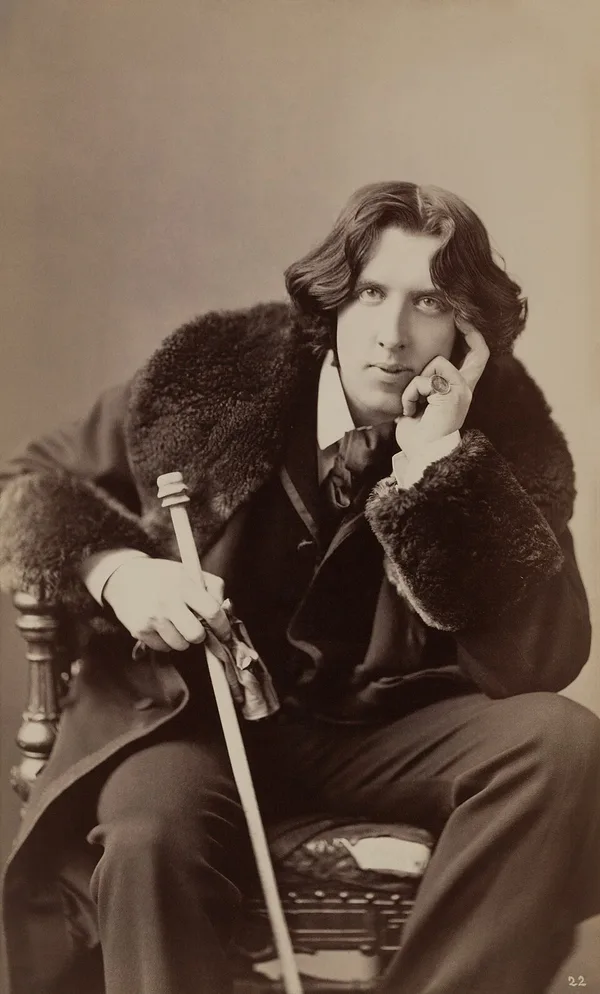
Oscar Wilde
Oscar Wilde
Oscar Fingal O'Flahertie Wills Wilde was born in Dublin on October 16, 1854. An Irish playwright, novelist, short-story writer and poet, he became, through his epigrammatic wit, one of the most successful and celebrated writers of late Victorian Britain. His life ended in a dramatic fall after a great rise: he died impoverished in a Paris hotel room on November 30, 1900.
Family and Early Years
Wilde was the second child of Sir William Wilde, a leading Irish eye surgeon, and Jane Francesca Wilde, a successful writer whose poetry had inspired the young Irish revolutionaries of the 1840s. His father was knighted in 1864 for his services to medicine. In June 1855 the family moved to a fashionable address at Merrion Square, where Wilde's sister Isola was born. Jane Wilde held Saturday salons attended by leading figures of the day such as Sheridan Le Fanu, Charles Lever, George Petrie, Isaac Butt and Samuel Ferguson.
Education
Wilde was educated at home until the age of nine and then attended Portora Royal School. He went on to study at Trinity College Dublin from 1871 to 1874. An outstanding student, he won the Berkeley Gold Medal, Trinity's highest award in classics, as well as a scholarship to Magdalen College, Oxford.
At Oxford, from 1874 to 1878, Wilde became part of the Aesthetic movement, one of whose central tenets was to make life approach art. At Magdalen he won the 1878 Newdigate Prize for his poem "Ravenna". He became known for his aesthetic ideas: he wore his hair long, openly scorned "manly" sports and decorated his rooms with lilies, peacock feathers, blue china and similar objects.
Influences
Wilde was deeply influenced by John Ruskin and Walter Pater, both of whom had written on the place of art in life. Echoing Pater, he would declare in the preface to The Picture of Dorian Gray that "all art is quite useless", a statement in keeping with the "art for art's sake" idea associated with the philosopher Victor Cousin. In 1879 Wilde began giving lectures on aestheticism in London.
America and Fame
After leaving Oxford, Wilde returned to Dublin, but he left Ireland in 1878 when Florence Balcombe became engaged to the writer Bram Stoker. He spent the next six years in Paris, London and the United States.
At the invitation of Richard D'Oyly Carte, Wilde arrived in America aboard the SS Arizona on January 3, 1882, for a lecture tour. He is said to have told a customs officer, "I have nothing to declare except my genius." During his tours of the United States and Canada he was ridiculed by many local critics, but his fame grew.
Marriage and Family
In London he met Constance Lloyd, daughter of the Queen's Counsel Horace Lloyd. They married in Paddington, London, on May 29, 1884. Constance's annual allowance of £250 allowed them to live in relative luxury. The couple had two sons, Cyril (1885) and Vyvyan (1886). After their father's notorious trial, Constance and the children took the surname Holland.
Journalism and Writing
Back in England, Wilde wrote reviews for the Pall Mall Gazette between 1887 and 1889 and became editor of The Woman's World. As England's leading aesthete, he became one of the most conspicuous personalities of his time. His major works include the novel "The Picture of Dorian Gray" (1890) and the plays "Lady Windermere's Fan" (1892), "An Ideal Husband" (1895) and "The Importance of Being Earnest" (1895).
Political Views
For much of his life Wilde sympathised with socialism, and he expressed his libertarian side in the poem "Sonnet to Liberty". As a pacifist, he observed that it would be hard to shake hands with liberty when it came with bloody hands. Besides his principal political essay, "The Soul of Man under Socialism", he wrote letters to the Daily Chronicle in support of prison reform.
Relationships
Wilde placed himself in a tradition of male love derived from Greek culture and described himself as Socratic. Historians generally say that he became aware of his homosexuality after becoming involved with the 17-year-old Robert Ross. In the summer of 1891 the poet Lionel Johnson introduced him to Lord Alfred Douglas, and an intense friendship began.
Trials and Imprisonment
In time Wilde's relationships with Douglas and with Alfred Taylor's circle attracted public attention. After Douglas's father, the Marquess of Queensberry, accused him of sodomy, Wilde brought a libel action against him; the trial opened on April 3, 1895, and collapsed, with the help of the actor Charles Brookfield and others, when evidence of Wilde's associations with young men from London's underworld emerged. Wilde himself was then prosecuted and, on May 25, 1895, sentenced to two years' hard labour for gross indecency.
Held first at Pentonville and then at Wandsworth, Wilde was finally transferred to Reading Gaol. Known as prisoner C.3.3., he was at first denied even pen and paper, though this was later allowed. In prison he wrote a 50,000-word letter to Douglas, which he was not permitted to send. After his death it was published in abridged form by Ross as "De Profundis"; the full text appeared in 1962 in "The Letters of Oscar Wilde".
Last Years and Death
Prison ruined Wilde's health, and he spent the remaining three years of his life penniless, though he soon returned to his old pleasures. "The Ballad of Reading Gaol" was published during these years.
Wilde died of meningitis on November 30, 1900. Shortly before his death he was received into the Catholic Church by Father Cuthbert Dunne. Among the remarks attributed to his last days is the famous quip about his hotel room's wallpaper: "One of us has got to go." He was first buried in the Cimetière de Bagneux, but his remains were later moved to the famous Père Lachaise Cemetery in Paris, beneath a tomb designed by Sir Jacob Epstein. His grave was long covered with the lipstick kisses of admirers.
Stories
Index
Poems
1 poems
Poet knowledge graph
A hierarchy of the poet’s poems and the words they use most.
Click a node to explore it; use the mouse wheel to zoom.