
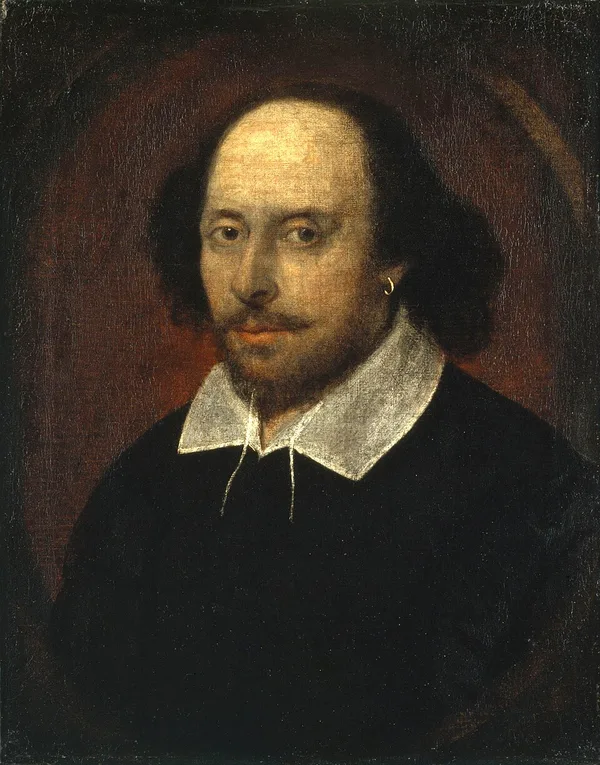
William Shakespeare
William Shakespeare
William Shakespeare was baptised on April 26, 1564, in Stratford-upon-Avon, England, and died on April 23, 1616. An English poet, playwright and actor, he is widely regarded as the greatest writer in the English language and the world's pre-eminent dramatist. He is often called England's national poet and "the Bard of Avon". His surviving works, including some collaborations, consist of 38 plays, 154 sonnets, two long narrative poems and a few other poems of uncertain authorship. His plays have been translated into every major language and are performed more often than those of any other playwright.
Life and Family
Shakespeare was the son of John Shakespeare, an alderman and successful glover, and Mary Arden, the daughter of an affluent landowning farmer. He was born in Stratford-upon-Avon and baptised on April 26, 1564. His actual date of birth is unknown, but it is traditionally observed on April 23, St George's Day. He was the third of eight children and the eldest surviving son.
Most biographers agree that Shakespeare was probably educated at the King's New School in Stratford, about a quarter of a mile from his home, which provided an intensive education in Latin grammar based on classical Latin authors.
At the age of 18 Shakespeare married the 26-year-old Anne Hathaway. The consistory court of the Diocese of Worcester issued a marriage licence on November 27, 1582. Six months after the marriage, their daughter Susanna was born and baptised on May 26, 1583. Twins, Hamnet and Judith, followed almost two years later and were baptised on February 2, 1585. Hamnet died of unknown causes at the age of 11 and was buried on August 11, 1596.
After the birth of the twins, Shakespeare left few historical traces until he is mentioned as part of the London theatre scene in 1592. Scholars refer to the years between 1585 and 1592 as Shakespeare's "lost years".
Theatrical Career
It is not known exactly when Shakespeare began writing, but performance records show that several of his plays were already on the London stage by 1592. From 1594 his plays were performed by the Lord Chamberlain's Men, a company of which he was a member and which soon became the leading playing company in London. After the death of Queen Elizabeth in 1603, the company was awarded a royal patent by the new king, James I, and renamed the King's Men.
In 1599 members of the company built their own theatre on the south bank of the River Thames, which they called the Globe. In 1608 the partners also took over the indoor Blackfriars Theatre. Records of Shakespeare's property purchases and investments show that the company made him a wealthy man: in 1597 he bought New Place, the second-largest house in Stratford, and in 1605 he invested in a share of the parish tithes in Stratford.
Shakespeare continued to act in his own and other plays after his success as a playwright. Throughout his career he divided his time between London and Stratford, and around 1610 he is thought to have retired to Stratford while continuing to visit London.
Shakespeare died on April 23, 1616, at the age of 52, survived by his wife and two daughters. He was buried in the chancel of Holy Trinity Church two days after his death. Some time before 1623, a funerary monument with a half-length effigy of him in the act of writing was erected in his memory.
Works
Shakespeare produced most of his known work between 1589 and 1613. Like most playwrights of the period, he often collaborated with others, especially early and late in his career.
Early Works
Shakespeare's earliest recorded works are Richard III and the three parts of Henry VI, written in the early 1590s. Titus Andronicus, The Comedy of Errors, The Taming of the Shrew and The Two Gentlemen of Verona are also thought to belong to his early period. His first history plays dramatise the destructive results of weak or corrupt rule and have been interpreted as a justification of the origins of the Tudor dynasty. His early plays were influenced by other Elizabethan dramatists, especially Thomas Kyd and Christopher Marlowe, by the traditions of medieval drama and by Seneca.
Comedies
In the mid-1590s Shakespeare's early classical and Italianate comedies, with their tight plots and precise comic sequences, gave way to the romantic atmosphere of his greatest comedies. A Midsummer Night's Dream is a witty mixture of romance, fairy magic and comic lowlife scenes. The Merchant of Venice contains the portrayal of the vengeful Jewish moneylender Shylock. The wit and wordplay of Much Ado About Nothing, the charming rural setting of As You Like It and the lively merrymaking of Twelfth Night complete Shakespeare's sequence of great comedies.
Tragedies
In the early seventeenth century Shakespeare wrote Measure for Measure, Troilus and Cressida, All's Well That Ends Well and several of his best-known tragedies. Many critics believe that his greatest tragedies represent the peak of his art. Hamlet, especially through the famous soliloquy beginning "To be, or not to be: that is the question", has probably been discussed more than any other Shakespearean character. The heroes of the following tragedies, Othello and King Lear, are undone by hasty errors of judgement. The plots of Shakespeare's tragedies often turn on such fatal errors or flaws, which overturn order and destroy the hero and those he loves. In Macbeth, the shortest and most compressed of his tragedies, uncontrollable ambition incites Macbeth and his wife, Lady Macbeth, to murder the rightful king. His last major tragedies, Antony and Cleopatra and Coriolanus, contain some of Shakespeare's finest poetry.
Late Works
In his last period Shakespeare turned to romance, or tragicomedy, and completed three more major plays besides Pericles, Prince of Tyre: Cymbeline, The Winter's Tale and The Tempest. Less bleak than the tragedies, these four plays are graver in tone than the comedies of the 1590s, but they end with reconciliation and the forgiveness of potentially tragic errors. Shakespeare also collaborated, most likely with John Fletcher, on two further surviving plays: Henry VIII and The Two Noble Kinsmen.
Poems
In 1593 and 1594, when the theatres were closed because of plague, Shakespeare published two narrative poems on erotic themes, Venus and Adonis and The Rape of Lucrece, dedicating them to Henry Wriothesley, Earl of Southampton. Both were well received and reprinted many times during his lifetime. "The Phoenix and the Turtle" was published in 1601 in Robert Chester's Love's Martyr.
Published in 1609, the Sonnets were the last of Shakespeare's non-dramatic works to be printed. Evidence suggests that he wrote sonnets throughout his career.
Legacy
In 1623 John Heminges and Henry Condell, two of Shakespeare's friends from the King's Men, published the First Folio, a collected edition of his plays. It contained 36 texts, 18 of them printed for the first time. Its preface included a poem by Ben Jonson which presciently hailed Shakespeare as "not of an age, but for all time".
Shakespeare was a respected poet and playwright in his own lifetime, but his reputation did not rise to its present heights until the nineteenth century. The Romantics in particular acclaimed his genius, and the Victorians revered him. In the twentieth century his work was repeatedly adopted and rediscovered by new movements in scholarship and performance. His plays remain hugely popular today and are constantly studied, performed and reinterpreted in diverse cultural and political contexts around the world.
Index
Poems
1 poems
Poet knowledge graph
A hierarchy of the poet’s poems and the words they use most.
Click a node to explore it; use the mouse wheel to zoom.