
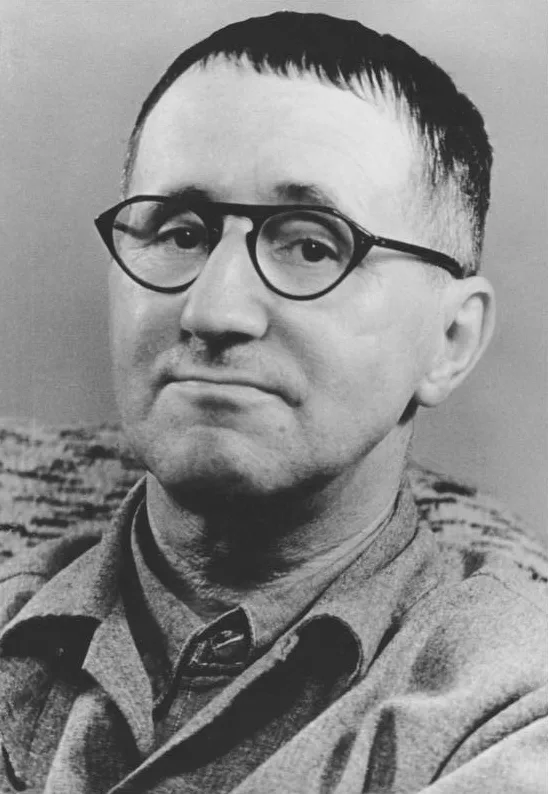
Bertolt Brecht
Bertolt Brecht
Eugen Berthold Friedrich Brecht, known as Bertolt or Bert Brecht, was born on February 10, 1898, in Augsburg, Bavaria, and died on August 14, 1956, in East Berlin. A German poet, playwright and theatre director, he is regarded as one of the most important figures of twentieth-century German poetry and theatre.
Early Life and Education
Brecht's father, Berthold Friedrich Brecht, was born in Achern and worked as a manager at the Haindl paper mill; his mother, Sophie, was born in Roßberg. Called "Eugen" in his youth, Brecht was a shy and sickly child. After primary school he attended the Peutinger Gymnasium from 1908 to 1917, graduating with the shortened examination introduced because of the war.
In a school essay on Horace's line "It is sweet and honourable to die for one's country", he dismissed the idea as a piece of propaganda for empty-headed people, openly declaring his opposition to the war. He narrowly escaped expulsion thanks to his father's standing and the intervention of his religion teacher.
In 1917–18 he studied natural science, medicine and literature at the Ludwig Maximilian University in Munich. In 1918 he had to interrupt his studies when he was assigned as a medical orderly to a military hospital in Augsburg. In 1919 he applied for leave from classes, which was granted, and on November 29, 1921, he was struck off the university register. In 1921–22 he enrolled in a philosophy faculty in Berlin but never began his studies.
Private Life
In 1916 he met his great youthful love, Paula Banholzer ("Bi"), with whom he had a son, Frank Banholzer, born on April 3, 1919, and named after the poet Frank Wedekind, whom Brecht greatly admired. Frank Banholzer was sent to the Eastern Front in the Second World War and was killed on November 13, 1943, in Porkhov, Russia, when a bomb hit a soldiers' cinema.
Brecht's mother died in 1920. That year he met the celebrated cabaret artist Karl Valentin, whose collaboration had a lasting influence on his later work. In 1922 he won the Kleist Prize for his play "Drums in the Night" and married the actress and opera singer Marianne Zoff; their daughter Hanne Hiob was born on March 12, 1923. Soon afterwards he met Helene Weigel, whom he would later marry, and in 1924 their son Stefan Brecht was born. He divorced Marianne Zoff in 1927 and married Weigel in 1929; their daughter Barbara Brecht-Schall was born in 1930.
Berlin and the Theatre
From 1920 Brecht travelled frequently to Berlin to build connections with theatre people and writers. There he met Arnolt Bronnen and changed his name to "Bertolt". He settled in Berlin in 1924, working first as a dramaturg with Carl Zuckmayer at Max Reinhardt's Deutsches Theater, having already directed his own work at the Munich Kammerspiele.
In the second half of the 1920s Brecht became a convinced communist, and his work came to serve his political aims. He described himself as a communist but never joined the German Communist Party. From 1926 onward he developed the idea of "epic theatre", or "dialectical theatre", a term previously used by Erwin Piscator, and put it into practice in his plays.
"The Threepenny Opera", with music by Kurt Weill, premiered on August 31, 1928, and became one of the greatest theatrical successes of the Weimar Republic, gaining worldwide fame. The same year he met Hanns Eisler, who became an important composer of his plays and songs; together they formed one of the most significant poet–composer partnerships of the twentieth century.
Brecht wanted his work to make social structures transparent and, above all, to show that they could be changed. For him, literature had to be of use. His Marxist thinking was shaped both by undogmatic Marxists outside the party, such as Karl Korsch, Fritz Sternberg and Ernst Bloch, and by the official Communist Party line.
Exile
In early 1933 police banned his play "The Measures Taken", and its organisers were charged with treason. On February 28, the day after the Reichstag fire, Brecht left Berlin with his family and friends. Travelling via Prague, Vienna and Zurich, he fled to Denmark and settled at Skovsbostrand on Funen, where he lived for five years. His books were burned by the Nazis in May 1933, and in 1935 he was stripped of his German citizenship.
In 1938 he wrote "Life of Galileo". Besides his plays, he wrote articles for exile newspapers in Prague, Paris and Amsterdam. In 1939 he left Denmark, lived for a year near Stockholm and moved to Helsinki in April 1940.
At the invitation of the Finnish writer Hella Wuolijoki he stayed at Marlebäck, where, based on her texts, he wrote "Mr Puntila and His Man Matti". In 1941 he travelled via Moscow on the Trans-Siberian Railway to Vladivostok, and from there by ship to California.
America
In the United States Brecht hoped to work as a screenwriter, with little success, and political work was impossible. "Life of Galileo" premiered at the Zurich Schauspielhaus on September 9, 1943; in 1947 he staged a new English version of the play in Los Angeles with Charles Laughton in the title role.
Accused of communist sympathies, he was questioned by the House Un-American Activities Committee on October 30, 1947. Asked whether he had ever been a member of the Communist Party, he answered "no", stating that he had not been a member in Germany either. The next day he left for Zurich via Paris. He stayed in Switzerland for a year, as it was the only country that would admit him; he was not permitted to enter West Germany.
In February 1948 his "Antigone of Sophocles" premiered at the Stadttheater in Chur, Switzerland. In 1950 Brecht and Weigel were granted Austrian citizenship. His long-time collaborator Kurt Weill died in New York that same year.
Return to East Berlin
After the war, friends urged Brecht to return to Germany and stage his plays himself. In October 1948, at the invitation of the East German Kulturbund, he travelled from Zurich via Salzburg and Prague to Berlin, as passage through the West was still barred to him. On arrival he quickly established contacts with leading artists and officials.
What mattered most to Brecht was working in the theatre again. He accepted Wolfgang Langhoff's offer to stage his own works at the Deutsches Theater, and after Erich Engel arrived in Berlin in 1949 they began rehearsing "Mother Courage and Her Children". Its premiere was an unprecedented success for Brecht, Engel and Weigel, who played the title role.
That same year the Berliner Ensemble was founded with Helene Weigel as its director, which suited Brecht: he would be spared the bureaucracy, and he could trust that Weigel would not force him into compromises for her own ambitions. In 1950, with other artists and intellectuals, he helped found the Academy of Arts of the newly established German Democratic Republic.
The premiere of "The Tutor" on April 15, 1950, was the ensemble's greatest success in Brecht's lifetime, and with it he was publicly recognised as a director for the first time. On October 7, 1951, he received the National Prize of the GDR, First Class.
On July 2, 1952, he moved with Helene Weigel to a house in Buckow, where until September 1953 he worked on the "Buckow Elegies" and the play "Turandot, or the Congress of Whitewashers". In 1953 he was elected president of the German PEN Centre (East and West).
Last Years and Death
In March 1954 the Berliner Ensemble moved into the Theater am Schiffbauerdamm, and that year Brecht became vice-president of the Academy of Arts. On December 18, 1954, he was awarded the Stalin Peace Prize. In 1954 and 1955 the ensemble performed in Paris and became an internationally known company, winning a prize at the 1955 Paris festival with "The Caucasian Chalk Circle".
In his final years Brecht worked intensely, staging two productions a year, taking part in nearly all the productions of the theatre's other directors and writing in every genre.
In May 1956 he fell ill with influenza and was admitted to the Charité hospital in Berlin. He spent the summer of 1956 resting by the Schermützelsee, some 50 km from Berlin. He suffered a heart attack on August 12, 1956, and died at 11:30 p.m. on August 14, 1956, at Chausseestraße 125 in Berlin, now the Brecht House. He was buried on August 17 in the presence of a vast crowd, many politicians and figures from cultural life; no speeches were made at the ceremony. His grave lies beside that of Helene Weigel, who died in 1971, in the Dorotheenstadt Cemetery, and has the status of a grave of honour.
Artistic Approach
Brecht often shaped his plays in response to their productions. Between 1918 and 1933 he carried out a range of artistic experiments within the possibilities offered by the stage. After he was forced to leave Germany his attitude changed, and with a few exceptions he wrote without regard to whether his plays would be staged. In this so-called "second period" he formed his own style, the "epic theatre".
Brecht wrote 48 plays and around 50 dramatic fragments, seven of them performable. "Baal" was his first play, followed in 1919 by "Drums in the Night". His greatest success was "The Threepenny Opera" (1928), with music by Kurt Weill. When "Rise and Fall of the City of Mahagonny" premiered in Leipzig in 1930, demonstrations, probably incited by his political opponents, made it one of the biggest theatre scandals in Germany.
Brecht used all the resources of modern theatre in designing his productions and drew on the help of specialists. Close collaboration with his students and associates, in which he himself remained in control, was normal for him.
Poetry
Brecht's poetic output was extraordinarily large, comprising some 2,300 poems, some of them in several versions. Expressing every important event and idea in poetic form was almost a necessity for him; even shortly before his death he wrote some twenty new poems. His poetry ranges from unrhymed texts to classical ballads in rhyming couplets.
Brecht believed that a poem should have "use value", and he gave this function and meaning to all his poems.
"Pirate Jenny", the song from "The Threepenny Opera", is featured on Art-ı Sanat.
Index
Poems
1 poems
Poet knowledge graph
A hierarchy of the poet’s poems and the words they use most.
Click a node to explore it; use the mouse wheel to zoom.