
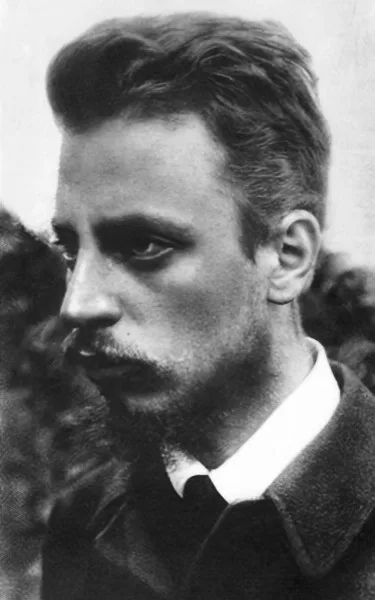
Rainer Maria Rilke
Rainer Maria Rilke
Rainer Maria Rilke was born in Prague on December 4, 1875, and died in Switzerland on December 29, 1926. An Austrian poet and novelist, he is regarded as the author of some of the most important works written in the German language. His poetry explores mysticism, subjective experience and the crisis of faith. His work includes one novel, many collections of poetry and several volumes of correspondence.
Childhood and Youth
Rilke was born in Prague, capital of Bohemia, then part of Austria-Hungary. His father, Josef Rilke, became a railway official after an unsuccessful military career; his mother, Sophie Entz, came from a wealthy Prague family. His parents' marriage ended in 1884. His childhood was overshadowed by his mother, who, mourning a daughter who had died in infancy, raised him almost as a girl.
His parents sent the poetically and artistically gifted boy to a military academy in Sankt Pölten, where he studied from 1886 to 1891 before leaving because of illness. He then attended a trade school in Linz. Expelled in May 1892, he returned to Prague to prepare for the university entrance examination and attended lectures in literature, art history and philosophy there. In 1896 he left for Munich.
Lou Andreas-Salomé and Russia
In Munich in 1897 Rilke met and fell in love with Lou Andreas-Salomé, a widely travelled intellectual. At her suggestion he changed his first name from "René" to "Rainer". His relationship with this married woman lasted until 1900, and together they made two extensive journeys to Russia, during which he met Leo Tolstoy, the family of Boris Pasternak and the peasant poet Spiridon Drozhzhin. Even after their separation, Salomé remained his most important confidante until the end of his life.
Worpswede and Marriage
In 1900 Rilke stayed at the artists' colony at Worpswede, where he met the sculptor Clara Westhoff, whom he married in 1901. Their daughter Ruth was born in December 1901. In the summer of 1902, however, Rilke left home for Paris to write a monograph on the sculptor Auguste Rodin, and Clara soon followed him. Although their relationship continued throughout their lives, the couple never formally divorced.
Paris and Artistic Transformation
Rilke's early days in Paris were difficult, an experience he described in his only novel, "The Notebooks of Malte Laurids Brigge". Yet his encounter with modernism proved inspiring. Rodin's sculpture and the paintings of Paul Cézanne made a deep impression on him; for a time he served as Rodin's secretary and wrote about his work. Learning from Rodin the value of objective observation, Rilke transformed his style, moving from the subjective, incantatory language of his earlier work to the "thing-poems" of the celebrated "New Poems".
This period produced "New Poems" (1907), "New Poems: The Other Part" (1908), the two "Requiem" poems (1909) and "The Notebooks of Malte Laurids Brigge", begun in 1904 and completed in January 1910. Paris increasingly became his main residence.
Duino and the War Years
From October 1911 to May 1912 Rilke was the guest of Princess Marie von Thurn und Taxis at Duino Castle near Trieste. There he began the cycle of poems that became the "Duino Elegies", which remained unfinished for a decade because of a long creative crisis. During this period he spent a long time in Ronda, Spain, and visited Toledo to see the paintings of El Greco.
The outbreak of the First World War caught Rilke in Germany. Unable to return to Paris, where his property was confiscated, he spent most of the war in Munich. Called up at the beginning of 1916, he underwent basic training in Vienna; thanks to the intervention of influential friends he was transferred to the War Records Office and discharged in June 1916. The traumatic experience of military service almost silenced him as a poet.
The Swiss Years and Late Works
On June 11, 1919, Rilke travelled from Munich to Switzerland. There he met the Polish-German painter Baladine Klossowska, with whom he had a relationship until his death in 1926. After living in various places in Switzerland, in mid-1921 he found a permanent home in the Château de Muzot near Sierre in the Valais.
In an intense creative burst in February 1922 he completed the "Duino Elegies" within a few weeks, and in the same period rapidly wrote the 55 "Sonnets to Orpheus". These two works are the high points of his career. His patron Werner Reinhart bought Muzot so that Rilke could live there rent-free.
During this period he met the Australian violinist Alma Moodie, whose playing moved him deeply. Between 1923 and 1926 he wrote many significant poems, including lyric poetry in French. In 1924 a poetic correspondence began with Erika Mitterer, to whom he replied with some fifty poems.
Political Views
Rilke supported the Russian Revolution of 1917 and the Bavarian Soviet Republic of 1919. He became friends with Ernst Toller and mourned the deaths of Rosa Luxemburg, Kurt Eisner and Karl Liebknecht. Known for his sympathy with left-wing causes, he became more reticent about politics after the Bavarian republic was crushed by the right-wing Freikorps. In 1926 he wrote letters praising Benito Mussolini and describing fascism as a healing force.
Death
Shortly before his death Rilke was diagnosed with leukaemia. He suffered ulcerous sores in his mouth and pain in his stomach and intestines. He died on December 29, 1926, at the Valmont sanatorium in Switzerland, in the arms of his doctor, with his eyes open. On January 2, 1927, he was buried in the churchyard at Raron, west of Visp. For his gravestone he chose an epitaph of his own: "Rose, oh pure contradiction, desire / to be no one's sleep under so many / lids."
Major Works
The Book of Hours: Published in April 1905, it consists of three cycles of poems. Drawing on the symbolism of St. Francis and his observations of Orthodox Christianity, it explores the search for God and the nature of prayer.
The Notebooks of Malte Laurids Brigge: His only novel, written while he lived in Paris and completed in 1910. A loosely structured, deeply poetic work, it includes a retelling of the parable of the Prodigal Son, vivid depictions of death, childhood memories and existential themes, using impressionistic techniques influenced by Nietzsche, Cézanne and Rodin.
Duino Elegies: Begun at Duino Castle in 1912 and completed at Muzot in February 1922, the cycle is regarded by critics and scholars as Rilke's most important work. These intensely religious, mystical poems use the symbolism of angels and salvation in ways that differ from Christian interpretations, and they address human existence, loneliness, the perfection of the angels, life and death, love and the task of the poet.
Sonnets to Orpheus: Written in 1922, inspired by the news of the death of Wera Ouckama Knoop, a friend of his daughter. The 55 sonnets are based on the myth of Orpheus and Eurydice and explore themes such as animals, people of different cultures, time and death.
Letters to a Young Poet: Published after his death, this collection of ten letters reached a very wide audience.
Style and Influence
To convey disbelief and the crisis of faith, Rilke made intensive use of metaphor, metonymy and paradox. Figures from Greek mythology such as Apollo, Hermes and Orpheus recur in his poems, and the angels described as "terrible" in the Duino Elegies hold an important place in his work.
His work influenced many poets, novelists and philosophers, among them William H. Gass, Galway Kinnell, Sidney Keyes, Stephen Spender, Robert Bly, W. S. Merwin, John Ashbery, Thomas Pynchon and Hans-Georg Gadamer. W. H. Auden has been described as "Rilke's most influential English disciple".
Rilke is one of the best-selling poets in the United States. His work is frequently referenced in television, film and music, is often described as "mystical" and is widely quoted by self-help authors.
Index
Poems
1 poems
Poet knowledge graph
A hierarchy of the poet’s poems and the words they use most.
Click a node to explore it; use the mouse wheel to zoom.