
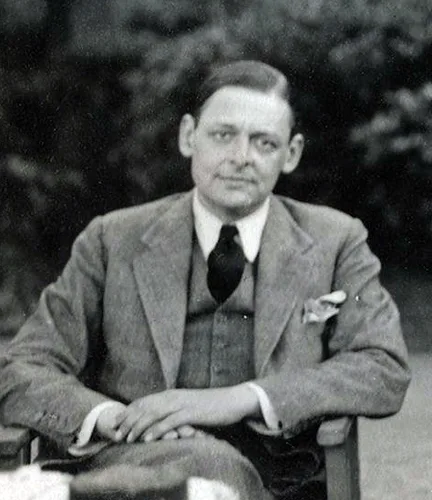
Thomas Stearns Eliot
Thomas Stearns Eliot
Thomas Stearns Eliot was born on September 26, 1888, in St. Louis, Missouri, into a family of Boston Brahmin descent. After studying at Harvard University, he moved to England in 1914, at the age of 25, and settled there. In 1927 he became a British subject and gave up his American citizenship. While working as a clerk at Lloyds Bank in London, he joined the Church of England; in 1925 he became a director of the publishing house Faber and Gwyer (later Faber and Faber), which went on to publish his poetry. He died in London on January 4, 1965.
Eliot is regarded as one of the greatest poets of the twentieth century and a central figure of English-language modernist poetry. Through his diction, style and verse structure he renewed English poetry, and he is also known for critical essays that often re-examined long-held cultural beliefs. He was awarded the 1948 Nobel Prize in Literature "for his outstanding, pioneer contribution to present-day poetry".
Literary Identity and Influences
Eliot's poetry grew out of a distinctive blend of his American and English backgrounds. In a 1959 interview he said that his poetry "wouldn't be what it is if I'd been born in England, and it wouldn't be what it is if I'd stayed in America", stressing that its sources and emotional springs came from America.
He was deeply influenced by French poets from Baudelaire to Paul Valéry. In his 1940 essay on W. B. Yeats he wrote that the kind of poetry he needed to teach him the use of his own voice did not exist in English at all and was only to be found in French. His poetry often reflects a desire to escape time-bound tradition; it draws heavily on the material of classical culture and represents a revolt against the cheerful, optimistic mood of nineteenth-century verse. He carried forward the movement of renewal begun by Yeats and Ezra Pound.
Output and Approach
Eliot's complete poetry is not large in volume. His collected poems and plays fill about 600 pages, of which the poems take up roughly 250. He himself remarked that his reputation in London rested on very few poems a year. According to Ezra Pound, "Eliot has paid the penalty of success", and the smallness of the penalty compared with the success was proof of his solid talent.
According to R. P. Blackmur, no modern critic exerted an influence on writers comparable to Eliot's; Blackmur attributed this to the strength of his integrity of character and called him, in the end, a dictator without parallel in our time.
Major Works
"The Love Song of J. Alfred Prufrock" (1915)
Eliot first drew attention with this poem, written between 1910 and 1911 and published in Poetry magazine at Ezra Pound's urging. Although the speaker, Prufrock, seems middle-aged, Eliot wrote most of the poem when he was only twenty-two. At a time when Georgian Poetry was admired, its famous opening, which compares the evening sky to "a patient etherized upon a table", was found shocking and offensive.
The poem follows the consciousness of one man in the stream-of-consciousness manner characteristic of the modernists. Prufrock suffers from physical and intellectual inertia, bound up with the recurring theme of unattained earthly love. The structure of the poem was deeply influenced by Eliot's extensive reading of Dante, and it contains many references to Hamlet and the French Symbolists. Its reception in London can be gauged from an unsigned review in The Times Literary Supplement of June 21, 1917, which declared that the fact that these things occurred to Mr. Eliot was surely of the very smallest importance to anyone, even to himself, and that they certainly had no relation to poetry.
"The Waste Land" (1922)
Published in The Criterion in October 1922, this poem is one of Eliot's masterpieces. The cuts and revisions that produced the published version from the manuscript were Ezra Pound's, and Eliot dedicated the poem to Pound as "il miglior fabbro" ("the better craftsman"). It was written during a period when Eliot's marriage was failing and both he and his wife Vivienne suffered from nervous disorders.
The poem is often read as an expression of the disillusionment of the post-war generation. Before its publication as a book in December 1922, Eliot distanced himself from its vision of despair; on November 15, 1922, he wrote to Richard Aldington that he no longer felt concerned about The Waste Land and was feeling his way toward a new form and style.
The poem is known for its complex structure, with shifts between satire and prophecy and abrupt changes of time, place and speaker. Its structural complexity, a poetic counterpart to James Joyce's Ulysses published the same year, is one reason it became a touchstone of modern literature. Among its best-known lines are "I will show you fear in a handful of dust", "April is the cruellest month" and the Sanskrit mantra that ends the poem, "Shantih shantih shantih".
"The Hollow Men" (1925)
For the critic Edmund Wilson, this poem, published in 1925, marked "the nadir of the phase of despair and desolation given such effective expression in The Waste Land". It is Eliot's major poem of the late 1920s. Its themes are overlapping and fragmentary: post-war Europe under the Treaty of Versailles, the difficulty of hope and religious conversion, and Eliot's failed marriage.
Allen Tate, noting a change in Eliot's method, wrote that in The Hollow Men "the mythologies disappear altogether". The poem contains some of Eliot's most famous lines, above all its conclusion: "This is the way the world ends / Not with a bang but a whimper."
"Ash-Wednesday" (1930)
This is the first long poem Eliot wrote after his conversion to Anglicanism in 1927. Published in 1930, it deals with the struggle of one who has lacked faith to acquire it. Sometimes called Eliot's "conversion poem", it moves from spiritual barrenness toward the hope of salvation.
Compared with the poems written before his conversion, Ash-Wednesday shows a marked change in style: it is less ironic, and the poems are no longer built from the voices of several characters. Its subjects centre on Eliot's spiritual concerns and Christian faith. Edwin Muir called it one of Eliot's most moving and perhaps his finest poem, while its traditionally Christian foundation surprised many secular readers.
"Four Quartets" (1936–1942)
Eliot regarded this sequence as his masterpiece, and it weighed heavily in the award of his Nobel Prize. It consists of four long poems, each first published separately: Burnt Norton (1936), East Coker (1940), The Dry Salvages (1941) and Little Gidding (1942). Each has five sections and offers meditations on the nature of time from theological, historical and physical perspectives, and each is associated with one of the four classical elements: air, earth, water and fire.
Burnt Norton is a meditative poem that opens with the narrator trying to focus on the present moment while walking in a garden; its final section reflects on the arts in their relation to time.
East Coker continues the exploration of time and meaning, with a famous passage on the nature of language and poetry. Out of the darkness Eliot offers a resolution: "I said to my soul, be still, and wait without hope."
The Dry Salvages treats the element of water through images of sea and river.
Little Gidding ("fire") is the most anthologised of the Quartets. Eliot's experiences as an air-raid warden during the Blitz give it its power; the narrator imagines meeting Dante during the German bombing. The Quartets end with the words of Julian of Norwich: "And all shall be well and / All manner of thing shall be well."
The Four Quartets cannot be understood without reference to Christian thought, tradition and history. Eliot drew on the theology, art, symbolism and language of figures such as Dante, St. John of the Cross and Julian of Norwich.
Other Works
Eliot usually published his poems first in periodicals or pamphlets and then collected them in books. His first collection was "Prufrock and Other Observations" (1917). In 1920 he published more poems in "Ara Vos Prec" (London) and "Poems" (New York). In 1925 he gathered The Waste Land and the poems of the earlier books in one volume, adding The Hollow Men, as "Poems 1909–1925", later updated as "Collected Poems".
In 1939 he published the light verse collection "Old Possum's Book of Practical Cats" ("Old Possum" was Ezra Pound's nickname for him). In 1954 the composer Alan Rawsthorne set six of the poems for speaker and orchestra as "Practical Cats". After Eliot's death the book became the basis of Andrew Lloyd Webber's musical "Cats", which opened in London's West End in 1981 and on Broadway the following year.
Posthumous publications include "Poems Written in Early Youth" (1967), made up of poems published in The Harvard Advocate between 1907 and 1910, and "Inventions of the March Hare: Poems 1909–1917" (1996), poems Eliot never intended to publish.
Plays
Eliot wrote seven plays, most notably "Murder in the Cathedral" (1935) and "The Cocktail Party" (1949), which form an important part of his literary legacy.
Index
Poems
12 poems
B
C
G
H
J
L
M
R
S
T
W
Poet knowledge graph
A hierarchy of the poet’s poems and the words they use most.
Click a node to explore it; use the mouse wheel to zoom.