
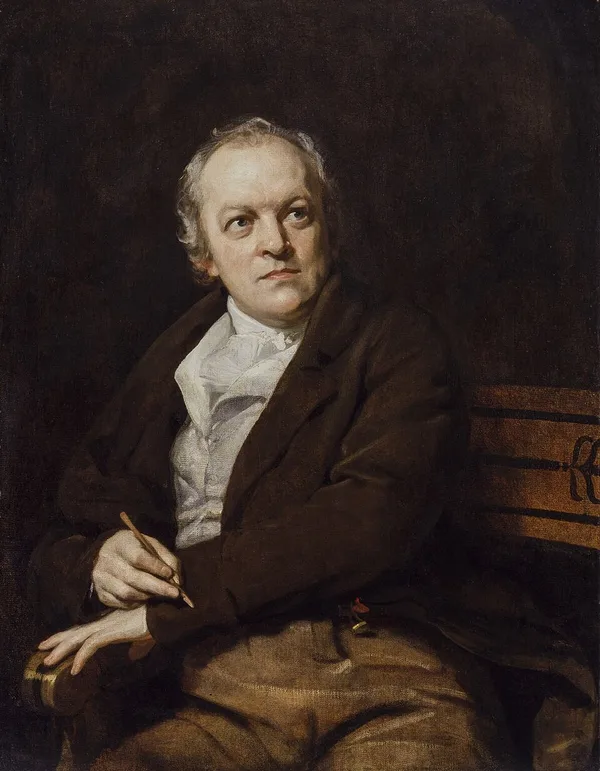
William Blake
William Blake
William Blake was born on November 28, 1757, at 28 Broad Street, near Golden Square in London, into a middle-class family. He was the third of seven children, two of whom died in infancy. His father was a hosier. Blake never attended school and was educated at home by his mother. His family were religious Dissenters, and his mother had links with the Moravian Church. The Bible had a profound influence on Blake from an early age and remained a source of inspiration throughout his life.
Blake's artistic journey began with copies of ancient Greek works that his father bought for him. Through the work of Raphael, Michelangelo, Maarten van Heemskerck and Albrecht Dürer he developed his love of classical forms. Knowing his headstrong character, his parents enrolled him in drawing classes rather than sending him to school. During this period he read avidly on subjects of his own choosing and studied poetry; his work shows a clear knowledge of Ben Jonson and Edmund Spenser.
On August 4, 1772, he was apprenticed for seven years to the engraver James Basire. At the end of this term, aged 21, he became a professional engraver. His experiences drawing in Westminster Abbey played an important part in shaping his artistic ideas. In 1779 he became a student at the Royal Academy, where he supplied his own materials. There he rebelled against what he regarded as the unfinished style of painters such as Rubens and came to detest the attitude to art of the Academy's first president, Joshua Reynolds.
In June 1780, during the Gordon Riots, Blake found himself caught up in the mob that stormed Newgate Prison. According to his biographer Alexander Gilchrist, he was swept along in the front rank of the crowd as it attacked the prison gates, set the building on fire and released the prisoners.
In 1782 he met John Flaxman, who would become his friend and supporter, and his future wife, Catherine Boucher. On August 18, 1782, he married Catherine, five years his junior, at St Mary's Church, Battersea. Being illiterate, she signed the marriage register with an "X". Blake later taught her to read and write and trained her as an engraver. Throughout his life Catherine gave him invaluable help, including colouring his illuminated books. The couple had no children. In these years George Cumberland, one of the founders of the National Gallery, became an admirer of Blake's work. Blake's first collection of poems, "Poetical Sketches", was printed around 1783.
His best-known books of poems, "Songs of Innocence" (1789) and "Songs of Experience" (1794), were produced by his own method of relief etching, combining text and image.
From 1800 to 1803 Blake lived in Felpham, Sussex. After returning to London he began writing and illustrating his most ambitious work, "Jerusalem". Having conceived a painting of the characters of Chaucer's "Canterbury Tales", he approached the dealer Robert Cromek to market an engraving of it. Cromek, however, thought Blake too eccentric to produce a popular work and gave the commission to Thomas Stothard. When Blake learned that he had been cheated, he broke off his friendship with Stothard and held an independent exhibition in his brother's shop. Through George Cumberland he met John Linnell, and through Linnell the young painter Samuel Palmer, a member of the group known as the Shoreham Ancients, who shared Blake's rejection of modern trends and his belief in a new spiritual and artistic age. At the age of 65 he began his illustrations for the "Book of Job", and his work, especially his biblical illustrations, began to find buyers.
On the day of his death, Blake was working relentlessly on his illustrations to Dante. Eventually he stopped and turned to his wife, who was in tears at his bedside. "Stay Kate! Keep just as you are – I will draw your portrait – for you have ever been an angel to me," he said. Having finished the portrait, he put down his tools and began to sing hymns. At six o'clock that evening, after promising his wife that he would always be with her, he died on August 12, 1827.
Largely unrecognised during his lifetime, Blake's work is now considered seminal in the history of both poetry and the visual arts, and one later critic called him "far and away the greatest artist Britain has ever produced". Although he rarely left London, apart from his three years at Felpham, his creative vision produced a diverse and symbolically rich body of work. He embraced the imagination as "the body of God", or "human existence itself". Considered mad by many contemporaries for his idiosyncratic views, Blake came to be highly esteemed by later critics for his expressiveness, creativity and the philosophical and mystical undercurrents of his work.
Because he emerged in the eighteenth century, his paintings and poetry belong both to the Romantic movement and to the pre-Romantic period. Reverent toward the Bible but hostile to the Church of England, Blake was influenced by thinkers such as Jakob Böhme and Emanuel Swedenborg and by the ideals of the French and American Revolutions. Despite these known influences, the originality of his work makes him hard to classify. The nineteenth-century scholar William Michael Rossetti described him as a "glorious luminary" and as "a man not forestalled by predecessors, nor to be classed with contemporaries, nor to be replaced by known or readily surmisable successors".
Stories
Index
Poems
1 poems
Poet knowledge graph
A hierarchy of the poet’s poems and the words they use most.
Click a node to explore it; use the mouse wheel to zoom.