
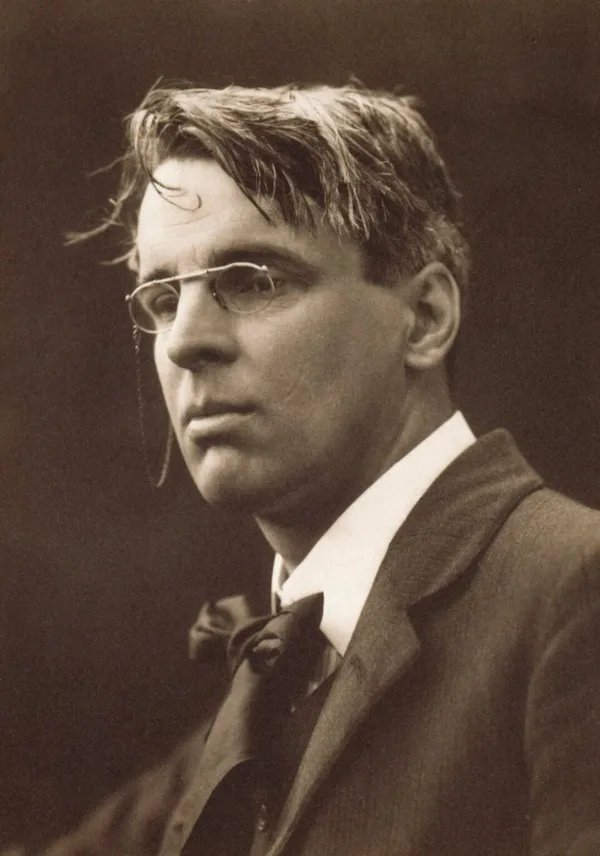
William Butler Yeats
William Butler Yeats
William Butler Yeats (June 13, 1865, Sandymount, Dublin – January 28, 1939, Menton, France) was an Irish poet and playwright. One of the most important lyric poets Ireland has produced, he is regarded as a foundational figure of twentieth-century literature. He was a driving force behind the Irish Literary Revival and one of the founders of the Abbey Theatre. He was awarded the Nobel Prize in Literature in 1923.
The son of the painter John Butler Yeats, he studied art in Dublin between 1883 and 1886. He spent his holidays in County Sligo, a region that often inspired his poetry, and in these years developed a deep interest in Irish legend and the occult.
His first work, "Mosada", was published in 1886 and reflected his interest in magic. In 1889 he published "The Wanderings of Oisin", based on Irish mythology. The poems he wrote between 1886 and 1900 show the influence of Shelley, Spenser and the Pre-Raphaelites; focused on Irish myth and themes, they are mystical, slow-moving and lyrical. "The Falling of the Leaves", "When You Are Old" and "The Lake Isle of Innisfree" are among the best-known poems of this period.
In 1893 he co-edited the works of William Blake, and in 1895 his collected poems appeared under the title "Poems". His later collections, such as "The Tower" (1928) and "The Winding Stair" (1933), are considered among the greatest achievements of modern poetry. His poem "Those Dancing Days Are Gone" was set to music by Carla Bruni on her 2007 album "No Promises". His book "The Celtic Twilight" has been translated into Turkish as "Kelt Şafağı".
"Sailing to Byzantium" (1928) is featured on Art-ı Sanat.
Index
Poems
1 poems
Poet knowledge graph
A hierarchy of the poet’s poems and the words they use most.
Click a node to explore it; use the mouse wheel to zoom.