
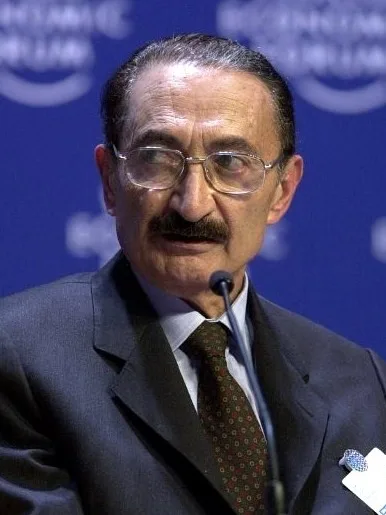
Bülent Ecevit
Bülent Ecevit
Mustafa Bülent Ecevit was born in Istanbul on May 28, 1925, and died in Ankara on November 5, 2006, of circulatory and respiratory failure. A major figure in Turkish political history, he was at once a journalist, poet, writer, translator and politician. During his political career he formed five governments and served as prime minister four times.
Family and Education
Ecevit's father, Fahri Ecevit, was a professor of forensic medicine at the Ankara Faculty of Law and served as a Republican People's Party (CHP) deputy for Kastamonu from 1943 to 1950. His mother, Fatma Nazlı, was a painter. His maternal great-grandfather was Hacı Emin Paşa, who served as Sheikh al-Islam of Mecca in the Ottoman period. Late in his life Ecevit donated some 110 decares of land he had inherited in Medina to Turkey's Directorate of Religious Affairs for the benefit of Turkish pilgrims.
After graduating from Robert College in 1944, he enrolled at the Ankara Faculty of Law and in the English Philology department of the Faculty of Language, History and Geography, but did not complete his higher education. During his years in England he studied English language and literature, Sanskrit, Bengali and art history at the University of London. In 1946 he married his schoolmate Rahşan Aral.
Journalism
Ecevit began working in 1944 as a translator at the General Directorate of Press and Publications. From 1946 to 1950 he worked as a clerk in the press attaché's office of the Turkish Embassy in London. In 1950 he joined Ulus, the CHP's newspaper, returning to it after his military service; when Ulus was closed, he worked as a writer and editor at Yeni Ulus and Halkçı.
In 1955 he worked in the United States as a guest journalist, and in 1957, on a Rockefeller Foundation fellowship, he studied social psychology and Middle Eastern history at Harvard University. In the 1950s he was on the editorial staff of the magazine Forum, and in 1965 he wrote a daily column for Milliyet. He founded the magazines "Özgür İnsan" (1972), "Arayış" (1981) and "Güvercin" (1988).
Early Political Career
Ecevit's political involvement began in 1954 when he joined the CHP's Çankaya branch. In the 1957 elections he entered parliament as a CHP deputy for Ankara. From 1961 to 1965 he served as Minister of Labour in the coalition governments led by İsmet İnönü, working for the passage of the Collective Bargaining, Strike and Lockout Law and the expansion of social security rights.
In 1966 he was elected secretary-general of the CHP and championed the "Left of Centre" line, which the party adopted as a core principle. After the military memorandum of March 12, 1971, he disagreed with İnönü and resigned as secretary-general; on May 14, 1972, he succeeded İnönü as party chairman.
CHP Chairmanship
His chairmanship of the CHP from 1972 to 1980 coincided with major developments in Turkish politics. In the general election of October 14, 1973, the CHP came first with 33.3 percent of the vote, and on January 26, 1974, Ecevit became prime minister for the first time at the head of a coalition with Necmettin Erbakan's National Salvation Party.
During this government the 1974 general amnesty was passed, and poppy cultivation, banned in June 1971, was permitted again on July 1, 1974. The most important event was the Turkish military intervention in Cyprus: following a coup backed by the Greek military junta, the operation began on July 20, 1974, and its second phase was completed on August 14. Afterwards Ecevit came to be called the "Conqueror of Cyprus".
The coalition lasted ten months and ended with Ecevit's resignation on September 18, 1974. In the 1977 general election the CHP raised its vote to 41.38 percent, the highest share ever won by a left-wing party in Turkey's multi-party era.
Becoming prime minister again in 1978, Ecevit reopened American bases in Turkey after the US arms embargo was lifted in September 1978. He stepped down after his party's defeat in the 1979 by-elections.
After September 12 and the DSP
After the military coup of September 12, 1980, Ecevit, like the other party leaders, was banned from politics for ten years. He and his wife Rahşan were held under surveillance in Gelibolu. Because of an article published in Arayış he was imprisoned from December 1981 to February 1982, and he was detained again from April to June 1982 for giving political statements to the foreign press.
In 1985, while the ban was still in force, the Democratic Left Party (DSP) was founded under the chairmanship of Rahşan Ecevit. When the ban was lifted by referendum in 1987, Ecevit became the party's leader. After the DSP failed to pass the electoral threshold in the 1987 election he announced his withdrawal from active politics, but he returned in 1989.
In the 1995 election the DSP's vote rose to 14.64 percent, making it the largest party on the left. In 1997 Ecevit served as deputy prime minister in the ANAP–DSP–DTP coalition, and on January 11, 1999, he formed a DSP minority government, becoming prime minister for the fourth time some twenty years after his previous term.
The most important event of this period was the capture of PKK leader Abdullah Öcalan in Kenya on February 15, 1999, and his transfer to Turkey. In the general election of April 18, 1999, the DSP came first with 22.19 percent of the vote, and on May 28, 1999, Ecevit again became prime minister at the head of a coalition with ANAP and the MHP.
The Gölcük earthquake of August 17, 1999, was a difficult period for the government. The Conditional Release and Suspension Law of 2000, proposed by Rahşan Ecevit and popularly known as the "Rahşan Amnesty", caused controversy.
In the 2002 general election the DSP received only 1.22 percent of the vote and failed to enter parliament. Ecevit left active politics at the DSP's sixth ordinary congress in 2004 and died on November 5, 2006. His wife Rahşan Ecevit died on January 17, 2020.
Ecevit was also a poet and translator; he translated Rabindranath Tagore, T. S. Eliot and Ezra Pound into Turkish. His "Turkish-Greek Poem", on the brotherhood of the two peoples, is featured on Art-ı Sanat.
Index
Poems
1 poems
Poet knowledge graph
A hierarchy of the poet’s poems and the words they use most.
Click a node to explore it; use the mouse wheel to zoom.