

The grey sea and the long black land;
And the yellow half-moon large and low;
And the startled little waves that leap
In fiery ringlets from their sleep,
As I gain the cove with pushing prow,
And quench its speed in the slushy sand.
II.
Then a mile of warm sea-scented beach;
Three fields to cross till a farm appears;
A tap at the pane, the quick sharp scratch
And blue spurt of a lighted match,
And a voice less loud, thro' its joys and fears,
Than the two hearts beating each to each!
Poet & Title
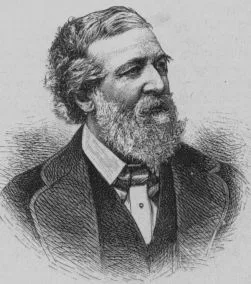
Robert Browning – “Meeting At Night”
Poem Text (as provided)
I.
The grey sea and the long black land;
And the yellow half-moon large and low;
And the startled little waves that leap
In fiery ringlets from their sleep,
As I gain the cove with pushing prow,
And quench its speed in the slushy sand.

II.
Then a mile of warm sea-scented beach;
Three fields to cross till a farm appears;
A tap at the pane, the quick sharp scratch
And blue spurt of a lighted match,
And a voice less loud, thro' its joys and fears,
Than the two hearts beating each to each!
Analytical Commentary
Robert Browning, known for his dramatic monologues and psychological depth, writes here a brief narrative that blends vivid imagery with an underlying emotional resonance. The poem is structured in two sections, each beginning with a capitalized numeral and a period, suggesting separate scenes or moments that together form a cohesive story of anticipation and reunion.
Section I – Setting the Stage
- Imagery of the Sea and Night: The “grey sea” and “long black land” establish a nocturnal maritime setting. The “yellow half-moon large and low” casts a dim, luminous glow that softens the darkness.
- “Startled little waves” in “fiery ringlets” convey motion and a sense of surprise or excitement, hinting at the narrator’s own heightened emotions.
- The line “As I gain the cove with pushing prow” introduces a ship, suggesting travel or escape. The phrase “quench its speed in the slushy sand” evokes a deliberate slowing, perhaps to prepare for an awaited encounter.
Section II – Journey and Anticipation
- The “warm sea-scented beach” contrasts with the earlier grey tone, hinting at a transition from the unknown to familiarity.
- “Three fields to cross till a farm appears” implies distance and obstacles before reaching a destination, adding tension.
- The sensory details of a “tap at the pane” and a “quick sharp scratch,” followed by an “blue spurt of a lighted match,” create a sudden, almost electric moment—perhaps the arrival of someone or something.
- The final couplet, “And a voice less loud, thro' its joys and fears / Than the two hearts beating each to each!” is pivotal. The “voice less loud” contrasts with the “two hearts beating each to each,” suggesting that the emotional connection between the two individuals is deeper and more resonant than any spoken word.
Form & Language
- The poem uses free verse, lacking a strict meter or rhyme scheme. This flexibility mirrors the fluidity of the sea and the unpredictability of human emotion.
- The diction is straightforward yet evocative, with occasional archaic phrasing (“thro'”) that lends a timeless quality.
Interpretation & Themes
- Anticipation & Arrival: The narrator’s journey across the sea and fields culminates in a meaningful encounter, possibly romantic or profound.
- Emotional Intimacy: The final line underscores that genuine connection transcends verbal communication; the heartbeats serve as a more powerful dialogue.
- Nature as Mirror: The sea and night reflect the internal state—calm, anticipation, eventual warmth.
In sum, Browning crafts a compact yet rich tableau that moves from the vastness of nature to the intimacy between two hearts, using imagery and sensory detail to convey the depth of human connection.
```More poems by Robert Browning
People who read this also read
Picked for you from the reading habits of our literary commons.
Poem knowledge graph
A literary network built from the poet who wrote this poem and the words poems have in common.
Click a node to explore it; use the mouse wheel to zoom.