
Etymology switcheroo
The way a crow
Shook down on me
The dust of snow
From a hemlock tree
Has given my heart
A change of mood
And saved some part
Of a day I had rued.
Loading annotations...
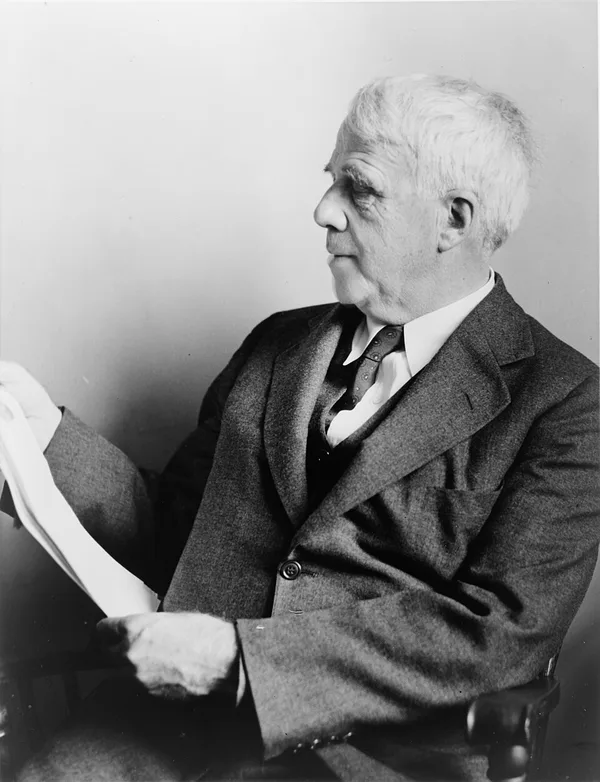
Poet: Robert Frost
Robert Frost (1874–1963) was an American poet renowned for his depictions of rural life and the intricacies of human emotion. His work often blends ordinary scenes with profound philosophical questions.
Dust Of Snow (Excerpt)
The way a crow Shook down on me The dust of snow From a hemlock tree Has given my heart A change of mood And saved some part Of a day I had rued.
Analysis
- Structure and Meter: The poem is written in free verse, lacking a regular rhyme scheme or strict meter. This fluidity mirrors the spontaneous nature of the imagery—an unexpected act by a crow.
- Imagery:
- The crow is traditionally associated with omens or death, yet here it becomes a catalyst for emotional change.
- The dust of snow conjures a fleeting, almost intangible quality—snow that has already melted or settled.
- Both the crow and the hemlock tree, a plant linked to death in folklore, create an eerie yet transformative scene.
- Theme – Transformation & Redemption: The speaker’s heart experiences a “change of mood,” suggesting that an initially bleak or mournful day is altered by this encounter. The line “saved some part of a day I had rued” indicates that the event has salvaged moments of regret, turning them into something valuable.
- Symbolism:
- The crow could symbolize death or misfortune, but in this context it acts as an agent of renewal.
- The hemlock tree, often associated with poison, adds a darker undertone that is softened by the “dust of snow,” implying purity or cleansing.
- “Dust” itself evokes impermanence, suggesting that even transient moments can have lasting emotional impact.
- Tone: The poem’s tone shifts from a neutral observation to an almost grateful reflection, as the speaker acknowledges how this small incident altered their emotional landscape.
- Interpretation: Frost may be illustrating how minor, seemingly negative occurrences can unexpectedly lead to personal growth. The “crow” might represent an external challenge that, when confronted, reveals hidden resilience.
Conclusion
This brief excerpt encapsulates Frost’s mastery of turning ordinary events into profound metaphors. By juxtaposing a crow, snow dust, and a hemlock tree, the poet invites readers to reconsider how fleeting moments shape our inner worlds.
Note: this analysis was generated automatically and is still under development.
More poems by Robert Frost
Poem knowledge graph
A literary network built from the poet who wrote this poem and the words poems have in common.
Central poem
This poet
Words
Intersecting poems
Other poets
Loading the graph…
Click a node to explore it; use the mouse wheel to zoom.