
I have walked out in rain — and back in rain.
I have outwalked the furthest city light.
I have looked down the saddest city lane.
I have passed by the watchman on his beat
And dropped my eyes, unwilling to explain.
I have stood still and stopped the sound of feet
When far away an interrupted cry
Came over houses from another street,
But not to call me back or say good-bye;
And further still at an unearthly height,
A luminary clock against the sky
Proclaimed the time was neither wrong nor right.
I have been one acquainted with the night.
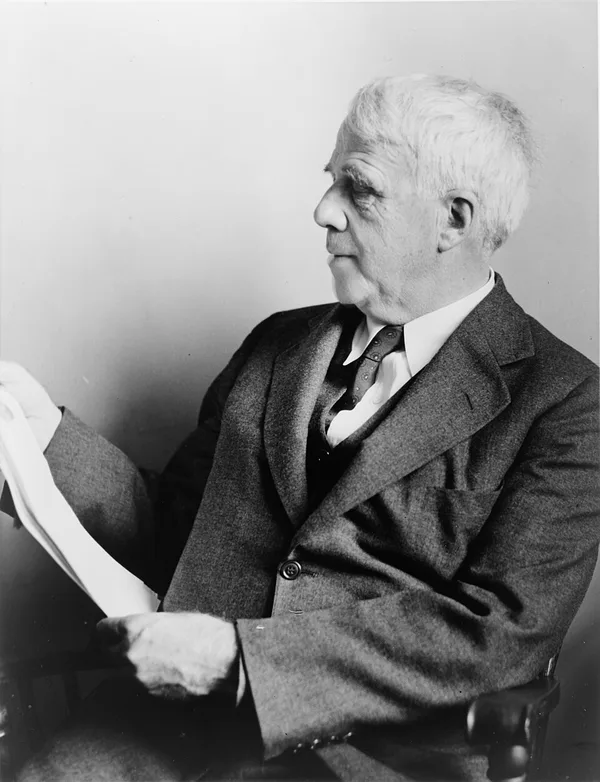
Poem Title: Acquainted With The Night Poet: Robert Frost
Structural Overview
- Stanzas: Four, each with three lines (except the last stanza, which also contains three lines).
- Meter: Roughly iambic tetrameter, though Frost allows for variations to accommodate natural speech.
- Rhyme Scheme: AABBCC… with an overall pattern of couplets that create a gentle, almost lullaby-like cadence.
Key Themes and Motifs
- Night as Companion: The narrator repeatedly claims to be “acquainted with the night,” suggesting a deep familiarity that borders on intimacy.
- Urban Isolation: The city is portrayed as a labyrinth of streets and lights that the narrator has “outwalked,” implying a sense of detachment from its bustle.
- Silence & Reflection: The narrator’s deliberate pause “to stop the sound of feet” and the introspective gaze toward the watchman highlight a contemplative mood.
- Temporal Uncertainty: The “luminary clock” that declares time as neither wrong nor right introduces a philosophical questioning of conventional temporal structures.
Imagery & Symbolism
- Rain: A cleansing, pervasive force that both washes and obscures.
- City Light & Watchman: Represent societal order and vigilance, which the narrator consciously avoids.
- Luminary Clock: A celestial timepiece that challenges human constructs of rightness and wrongness, hinting at a larger cosmic perspective.
Interpretive Angles
1. Existential Solitude: The narrator’s night walks can be read as a search for meaning in an indifferent urban landscape.
2. Rejection of Conventional Time: By refusing to accept the clock’s claim, the speaker resists society’s imposed schedules and moral judgments.
3. The Night as a Sanctuary: The night offers an escape from the “watchman” and “city lights,” allowing for introspection and authenticity.
Stylistic Observations
- The poem’s conversational tone, combined with precise imagery, creates a balance between lyrical beauty and ordinary realism.
- Frost’s use of repetition (“I have been one acquainted with the night”) reinforces the central motif and provides rhythmic closure.
Overall, Acquainted With The Night invites readers to consider how the nocturnal environment can become a space for reflection, resistance, and redefinition of time and self.
More poems by Robert Frost
People who read this also read
Picked for you from the reading habits of our literary commons.
Poem knowledge graph
A literary network built from the poet who wrote this poem and the words poems have in common.
Click a node to explore it; use the mouse wheel to zoom.