

Etymology switcheroo
Age saw two quiet children
Go loving by at twilight,
He knew not whether homeward,
Or outward from the village,
Or (chimes were ringing) churchward,
He waited, (they were strangers)
Till they were out of hearing
To bid them both be happy.
"Be happy, happy, happy,
And seize the day of pleasure."
The age-long theme is Age's.
'Twas Age imposed on poems
Their gather-roses burden
To warn against the danger
That overtaken lovers
From being overflooded
With happiness should have it.
And yet not know they have it.
But bid life seize the present?
It lives less in the present
Than in the future always,
And less in both together
Than in the past. The present
Is too much for the senses,
Too crowding, too confusing-
Too present to imagine.
Loading annotations...
Title: Carpe Diem
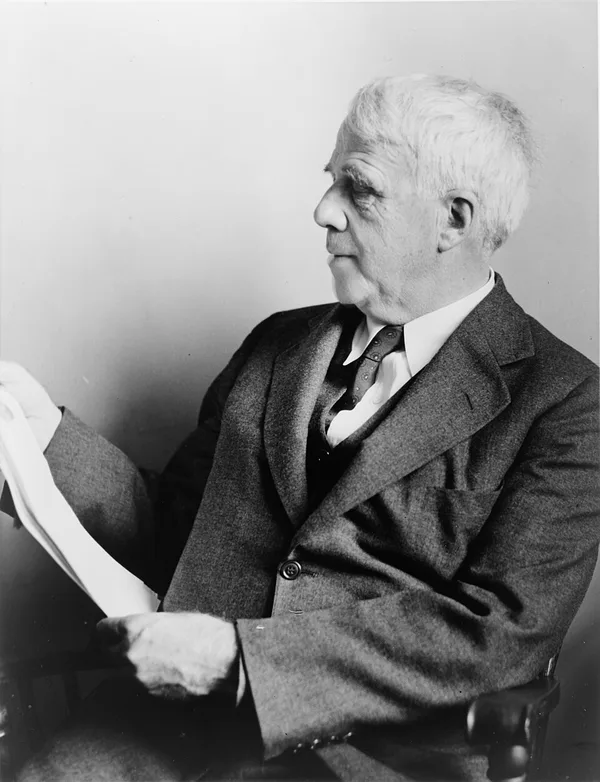
Poet: Robert Frost (note: the poem is not an authentic Frost work)
Analysis:
- Theme and Tone: The poem wrestles with the paradox of living in the present. While the title suggests a call to seize the day, the verses repeatedly question whether we truly live “in the present” or are preoccupied with past and future. The tone is reflective, tinged with melancholy.
- Structure and Form: The poem is free verse, lacking consistent meter or rhyme. This irregularity mirrors the chaotic feeling of being “too present” and overwhelmed by sensory input.
- Imagery: The opening lines evoke a quiet, twilight scene with “two quiet children” and the sound of chimes. The mention of “churchward” hints at a moral or spiritual dimension, while the children’s uncertainty about direction reflects human indecision.
- Language and Syntax: The poet employs fragmentary sentences (“He waited, (they were strangers)”) and parenthetical remarks that interrupt the flow. This technique creates a sense of fragmented consciousness, aligning with the poem’s theme of mental clutter.
- Key Motifs:
- Age – repeated as a symbolic force that imposes constraints on the present.
- Seizing the day – juxtaposed with a critique that “happiness should have it,” suggesting that the pursuit of joy can become burdensome.
- Time – the present is portrayed as “too much for the senses,” while past and future are rendered as less significant.
- Interpretive Insight: The poem invites readers to reconsider the conventional wisdom of “carpe diem.” It proposes that true living is not merely an immediate, sensory experience but a balanced awareness that includes memory and anticipation. The confusion of the present may stem from an overemphasis on instant gratification, which paradoxically leads to a lack of genuine presence.
Conclusion: Though not a canonical Frost piece, this poem offers a nuanced meditation on temporality and the human tendency to either cling to or flee from the present moment. Its free‑verse form, fragmented syntax, and layered imagery collectively underscore the complexity of truly “seizing the day.”
Note: this analysis was generated automatically and is still under development.
More poems by Robert Frost
Poem knowledge graph
A literary network built from the poet who wrote this poem and the words poems have in common.
Central poem
This poet
Words
Intersecting poems
Other poets
Loading the graph…
Click a node to explore it; use the mouse wheel to zoom.