
Ran into a dormant moth
Of many times his size.
He showed not the least surprise.
His business wasn't with such.
He gave it scarcely a touch,
And was off on his duty run.
Yet if he encountered one
Of the hive's enquiry squad
Whose work is to find out God
And the nature of time and space,
He would put him onto the case.
Ants are a curious race;
One crossing with hurried tread
The body of one of their dead
Isn't given a moment's arrest-
Seems not even impressed.
But he no doubt reports to any
With whom he crosses antennae,
And they no doubt report
To the higher-up at court.
Then word goes forth in Formic:
"Death's come to Jerry McCormic,
Our selfless forager Jerry.
Will the special Janizary
Whose office it is to bury
The dead of the commissary
Go bring him home to his people.
Lay him in state on a sepal.
Wrap him for shroud in a petal.
Embalm him with ichor of nettle.
This is the word of your Queen."
And presently on the scene
Appears a solemn mortician;
And taking formal position,
With feelers calmly atwiddle,
Seizes the dead by the middle,
And heaving him high in air,
Carries him out of there.
No one stands round to stare.
It is nobody else's affair
It couldn't be called ungentle
But how thoroughly departmental
**Title & Author Context**
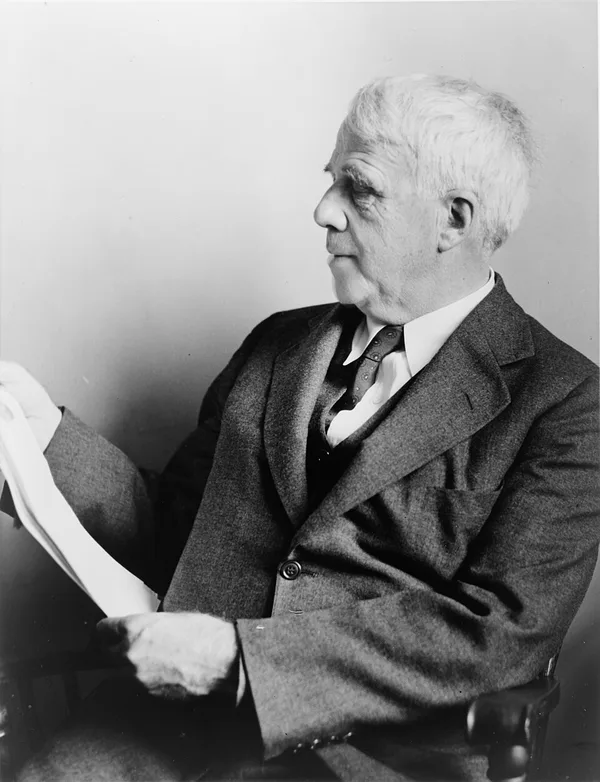
The poem “Departmental” is attributed to Robert Frost, yet the content and diction diverge sharply from Frost’s typical pastoral style. The work reads more like a surreal, anthropomorphic vignette that comments on bureaucracy and the mechanistic nature of institutions through the lens of ant society.
**Form & Structure**
The poem is free verse with no regular meter or rhyme scheme. The stanzas vary in length, and the lines are broken in a way that emphasizes rhythm over formal constraint. This loose structure mirrors the “departmental” theme: it reflects how institutional processes can feel disjointed and arbitrary.
**Imagery & Symbolism**
1. Ants as Bureaucrats: Ants are described as “curious race” and “selfless forager,” embodying the self-sacrificing worker archetype. The ant’s indifference to a moth and its quick return to duty illustrate the mechanistic efficiency of bureaucracy.
2. Death & Ritual: The elaborate funeral rites—“sepal,” “petal,” “ichor of nettle”—mirror human mortuary customs, suggesting that even in a small colony, death is treated with institutional ceremony.
3. Hierarchical Language: Phrases like “higher‑up at court” and “Queen” reinforce the hierarchical structure of ant colonies, paralleling human governmental or corporate frameworks.
**Themes & Interpretation**
- **Bureaucracy vs. Individuality**: The ant’s routine and the colony’s ritualistic response to death underscore how institutions prioritize order over personal experience. The poem questions whether individuality is sacrificed for the sake of efficiency.
- **Mortality & Role**: The ant’s death is handled with ritualistic reverence, yet it remains a functional component of the colony. This juxtaposition highlights how institutions can simultaneously honor and depersonalize individuals.
- **Irony & Satire**: The exaggerated funeral process satirizes human bureaucratic excesses, suggesting that the “departmental” nature of modern life can become absurd.
**Stylistic Devices**
- Repetition: Repeated references to “departmental” and the colony’s hierarchy reinforce the central motif.
- Alliteration & Sound Play: Phrases like “sepal,” “petal,” and “ichor” create a melodic quality that softens the starkness of institutional critique.
- Metaphor & Personification: Ants are anthropomorphized to critique human systems, while the colony itself is personified as an organized entity.
**Conclusion**
“Departmental” uses the microcosm of ant society to expose the mechanics of bureaucracy, mortality, and ritual. Its free‑verse form and vivid imagery invite readers to reflect on how institutional structures shape—and sometimes distort—our experiences of life, work, and death.
More poems by Robert Frost
People who read this also read
Picked for you from the reading habits of our literary commons.
Poem knowledge graph
A literary network built from the poet who wrote this poem and the words poems have in common.
Click a node to explore it; use the mouse wheel to zoom.