
Etymology switcheroo
Who says that all must vanish?
Who knows, perhaps the flight
of the bird you wound remains,
and perhaps flowers survive
caresses in us, in their ground.
It isn't the gesture that lasts,
but it dresses you again in gold
armor —from breast to knees—
and the battle was so pure
an Angel wears it after you.
Translated by A. Poulin
Loading annotations...
Poem Title: What Survives
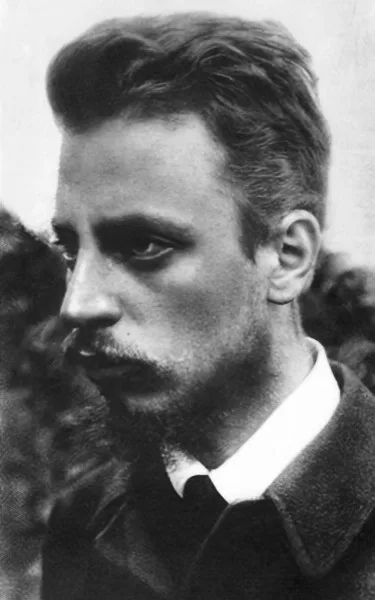
Original Poet: Rainer Maria Rilke
Analysis of the Poem
1. Thematic Overview
- The poem interrogates the common belief that everything inevitably disappears, suggesting instead that certain aspects—like a wounded bird’s flight or the lingering touch of flowers—persist in subtle, transformative ways.
- It shifts from physical loss to an internal, almost spiritual continuity: the idea that gestures and memories “dress” us again in golden armor.
- The concluding image of an angel wearing the armor implies a transcendence beyond mortal conflict, hinting at an enduring moral or spiritual essence.
2. Imagery and Symbolism
- Bird’s flight after being wounded: Symbolizes resilience and the possibility of renewal even after trauma.
- Flowers’ caresses: Represents fleeting beauty that, though transient, leaves a lasting impression in our inner landscape.
- Golden armor: A metaphor for the protective strength that memory and experience confer upon us.
- The armor’s range “from breast to knees” emphasizes a comprehensive covering—physical, emotional, and spiritual.
- The angelic figure suggests divine approval or sanctification of this inner armor.
3. Structural Observations
- The poem is concise, with a free verse structure that allows the imagery to flow without rigid meter.
- The use of an em dash in “armor —from breast to knees—” creates a deliberate pause, emphasizing the completeness of protection.
- Rilke’s original language is known for its dense metaphoric layers; the translation preserves this density while making it accessible.
4. Translational Fidelity
- The translator, A. Poulin, has retained the poem’s core metaphors and rhythmic balance.
- Some nuances, such as the specific phrasing “caresses in us,” might reflect a more poetic license to capture Rilke’s contemplative tone.
- Overall, the translation maintains the lyrical quality and thematic depth of the original.
5. Interpretive Takeaway
- The poem invites readers to reconsider loss not as an absolute end but as a transformation that equips us with inner strength.
- It suggests that what survives is not the tangible object but the enduring impact it leaves—memories, lessons, and a fortified spirit.
In summary, “What Survives” uses vivid natural and spiritual imagery to challenge the finality of disappearance, proposing that resilience, memory, and moral fortitude are the true survivors in our lives.
Note: this analysis was generated automatically and is still under development.
More poems by Rainer Maria Rilke
People who read this also read
Picked for you from the reading habits of our literary commons.
Poem knowledge graph
A literary network built from the poet who wrote this poem and the words poems have in common.
Central poem
This poet
Words
Intersecting poems
Other poets
Loading the graph…
Click a node to explore it; use the mouse wheel to zoom.