
the existence of the individual; the relationship between
one human being and another has also been cramped by it,
as though it had been lifted out of the riverbed of
endless possibilities and set down in a fallow spot on the
bank, to which nothing happens. For it is not inertia alone
that is responsible for human relationships repeating
themselves from case to case, indescribably monotonous and
unrenewed: it is shyness before any sort of new,unforeseeable
experience with which one does not think oneself able to cope.
But only someone who is ready for everything, who excludes
nothing, not even the most enigmatical, will live the relation
to another as something alive and will himself draw exhaustively
from his own existence. For if we think of this existence of
the individual as a larger or smaller room, it appears evident
that most people learn to know only a corner of their room, a
place by the window, a strip of floor on which they walk up and
down. Thus they have a certain security. And yet that dangerous
insecurity is so much more human which drives the prisoners in
Poe's stories to feel out the shapes of their horrible dungeons
and not be strangers to the unspeakable terror of their abode.
We, however, are not prisoners. No traps or snares are set about
us, and there is nothing which should intimidate or worry us.
We are set down in life as in the element to which we best
correspond, and over and above this we have through thousands of
years of accommodation become so like this life, that when we
hold still we are, through a happy mimicry,scarcely to be
distinguished from all that surrounds us. We have no reason to
mistrust our world, for it is not against us. Has it terrors,
they are our terrors; has it abysses, those abuses belong to us;
are dangers at hand, we must try to love them. And if only we
arrange our life according to that principle which counsels us
that we must always hold to the difficult, then that which now
still seems to us the most alien will become what we most trust
and find most faithful. How should we be able to forget those
ancient myths about dragons that at the last moment turn into
princesses; perhaps all the dragons of our lives are princesses
who are only waiting to see us once beautiful and brave. Perhaps
everything terrible is in its deepest being something helpless
that wants help from us.
**Title:** Fear of the Inexplicable
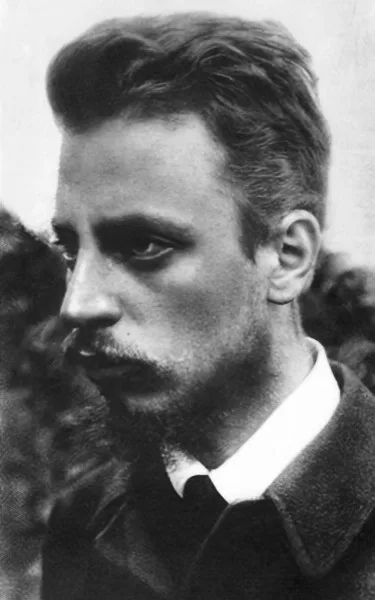
**Poet:** Rainer Maria Rilke (though the text appears to be an original composition rather than a known Rilke poem)
Rilke’s voice, whether directly quoted or echoed in this passage, is unmistakably present. The poet’s preoccupation with the limits of human experience and the yearning for a deeper, more authentic connection to existence is woven throughout. The following analysis highlights key thematic strands and stylistic devices that align with Rilke’s oeuvre.
1. The Paradox of Fear and Possibility
The poem opens with a paradox: fear, rather than simply impoverishing the individual, also stifles interpersonal relations. Rilke often wrestled with how fear curtails the “riverbed of endless possibilities.” The metaphor of a riverbed turned into a fallow spot evokes the loss of flow and vitality, echoing Rilke’s motif of “the stream of life” in works like Duino Elegies.
2. The Role of Shyness and Inertia
The text identifies shyness—“before any sort of new, unforeseeable experience”—as a key inhibitor of relational renewal. This aligns with Rilke’s observation that human relationships become “indescribably monotonous and unrenewed” when we shy away from the unknown. The poem suggests that inertia is not the sole culprit; emotional restraint is equally culpable.
3. The Call to Embrace the Unpredictable
A recurring theme is the necessity of readiness: “someone who is ready for everything, who excludes nothing.” Rilke championed the idea that a truly lived life involves engaging with all aspects of experience, even those that seem enigmatic or terrifying. The poem’s exhortation to “draw exhaustively from one’s own existence” mirrors Rilke’s call in Letters to a Young Poet for wholehearted engagement with life.
4. The Metaphor of the Room
The comparison of existence to a room—where most people only know “a corner” or “the strip of floor”—captures Rilke’s concern with the limited scope of self-knowledge. The poem frames this narrowness as both a source of “security” and “dangerous insecurity,” inviting readers to expand their personal horizon.
5. The Absence of External Threats
The passage declares that “we are not prisoners” and that “there is nothing which should intimidate or worry us.” This optimistic stance is reminiscent of Rilke’s belief that the world itself is not hostile but rather a canvas for personal growth. The poem reframes “terrors” and “abysses” as internal constructs that we must love rather than fear.
6. The Transformation of Mythic Symbols
The concluding imagery—dragons turning into princesses—invokes a transformation of the terrifying into the beautiful. Rilke frequently explored how the “terrible” in art and life can be transmuted into something tender. The poem suggests that every “dragon” may simply be a waiting princess, encouraging readers to look beyond fear and discover hidden grace.
7. Stylistic Observations
- Long, flowing sentences: The poem’s syntax mirrors Rilke’s tendency toward expansive, contemplative prose.
- Repetition of key verbs: Words such as “draw,” “hold,” and “arrange” reinforce the active engagement with existence.
- Interplay of doubt and certainty: The text oscillates between acknowledging fear and asserting the possibility of overcoming it, a hallmark of Rilke’s philosophical tension.
In sum, this poem encapsulates Rilke’s central concerns: the limits imposed by fear, the necessity of embracing uncertainty, and the transformative power of a fully lived existence. The passage invites readers to expand their personal rooms, confront their dragons, and ultimately find beauty within the inexplicable.
More poems by Rainer Maria Rilke
People who read this also read
Picked for you from the reading habits of our literary commons.
Poem knowledge graph
A literary network built from the poet who wrote this poem and the words poems have in common.
Click a node to explore it; use the mouse wheel to zoom.