
Etymology switcheroo
Tyger! Tyger! burning bright
In the forest of the night
What immortal hand or eye
Could frame thy fearful symmetry?
In what distant deeps or skies
Burnt the fire of thine eyes?
On what wings dare he aspire?
What the hand dare seize the fire?
And what shoulder, and what art,
Could twist the sinews of thy heart?
And when thy heart began to beat,
What dread hand? and what dread feet?
What the hammer? what the chain?
In what furnace was thy brain?
What the anvil? what dread grasp
Dare its deadly terrors clasp?
When the stars threw down their spears,
And watered heaven with their tears,
Did he smile his work to see?
Did he who made the lamb make thee?
Tyger! Tyger! burning bright
In the forests of the night,
What immortal hand or eye
Dare frame thy fearful symmetry?
Loading annotations...
Title and Author
- Poem Title: The Tyger
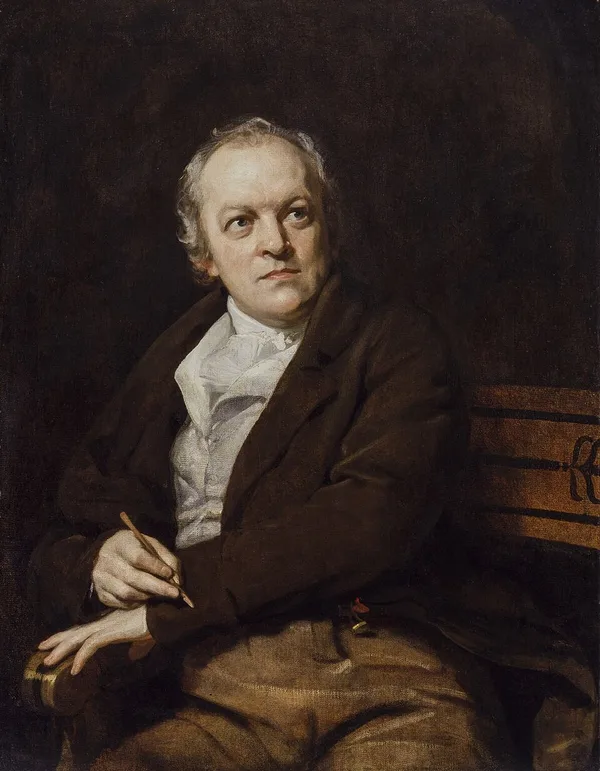
- Poet: William Blake (1757–1827)
Historical Context
- Written in 1794, a period of the Romantic movement that celebrated emotion, nature, and individual imagination.
- Blake’s work often juxtaposed innocence (the lamb) with experience and darkness (the tiger), reflecting his own complex views on faith, creation, and the nature of evil.
Formal Analysis
- Structure: The poem consists of eight quatrains with an ABAB rhyme scheme, creating a rhythmic chant that mirrors the ferocious subject.
- Meter: Predominantly trochaic tetrameter, giving a steady, marching beat that underscores the tiger’s power.
- Repetition: The opening and closing lines (“Tyger! Tyger! burning bright…”) bookend the poem, reinforcing the central image.
- Imagery: Vivid, often paradoxical images such as “burning bright” and “forest of the night” heighten the tension between light and darkness.
Key Themes
- Creation & Divine Power: The poem questions the hand that forged such a creature, implying divine or supernatural agency.
- Duality of Good & Evil: The juxtaposition of the tiger with the lamb explores the coexistence of beauty and terror in creation.
- Human Curiosity & Fear: The repeated questions reflect humanity’s attempt to understand forces beyond its control.
Interpretive Insights
- The tiger symbolizes the sublime—something that is both awe-inspiring and terrifying.
- Blake’s use of “fire” and “steel” imagery suggests industrialization’s impact on nature, hinting at the era’s anxieties.
- The poem can be read as a meditation on God’s role in creating both benevolent and malevolent aspects of the world.
Critical Reception
- Regarded as a masterpiece of Romantic poetry, it is frequently studied for its exploration of duality and its striking musicality.
- Critics note Blake’s masterful use of language to create an almost hypnotic effect, drawing readers into the tiger’s ferocious presence.
Overall, William Blake’s “The Tyger” remains a powerful inquiry into the mysteries of creation and the nature of existence, resonating with readers across centuries.
Note: this analysis was generated automatically and is still under development.
More poems by William Blake
People who read this also read
Picked for you from the reading habits of our literary commons.
Poem knowledge graph
A literary network built from the poet who wrote this poem and the words poems have in common.
Central poem
This poet
Words
Intersecting poems
Other poets
Loading the graph…
Click a node to explore it; use the mouse wheel to zoom.