
Etymology switcheroo
TURNING and turning in the widening gyre
The falcon cannot hear the falconer;
Things fall apart; the centre cannot hold;
Mere anarchy is loosed upon the world,
The blood-dimmed tide is loosed, and everywhere
The ceremony of innocence is drowned;
The best lack all conviction, while the worst
Are full of passionate intensity.
Surely some revelation is at hand;
Surely the Second Coming is at hand.
The Second Coming! Hardly are those words out
When a vast image out of Spiritus Mundi
Troubles my sight: somewhere in sands of the desert
A shape with lion body and the head of a man,
A gaze blank and pitiless as the sun,
Is moving its slow thighs, while all about it
Reel shadows of the indignant desert birds.
The darkness drops again; but now I know
That twenty centuries of stony sleep
Were vexed to nightmare by a rocking cradle,
And what rough beast, its hour come round at last,
Slouches towards Bethlehem to be born?
Loading annotations...
<p>**Title & Author Context**
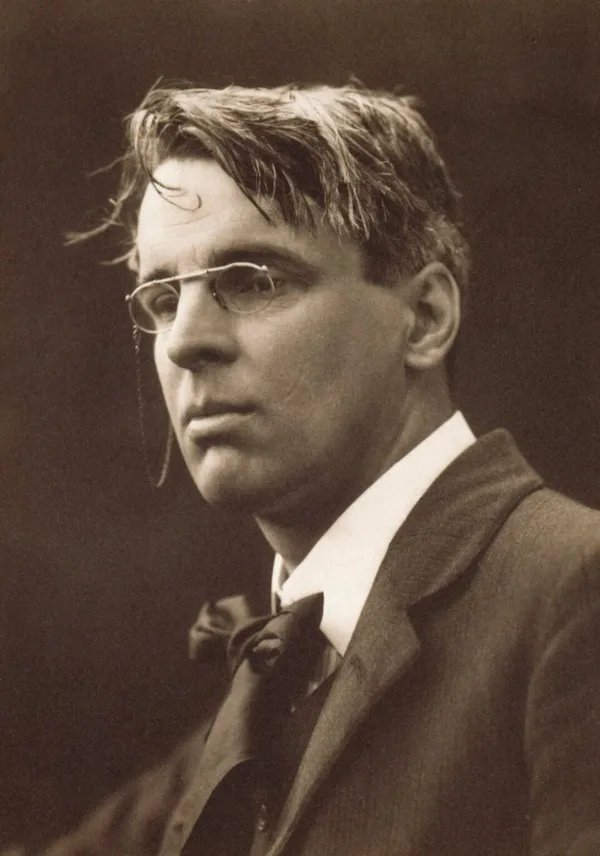
The poem is William Butler Yeats’ “The Second Coming,” written in 1919, a period of post‑World War I disillusionment and the rise of new political ideologies. Yeats, deeply influenced by mysticism and Irish nationalism, uses the poem to voice his anxiety about societal collapse and a looming, ominous transformation.</p>

<p>**Structure & Form**
Yeats divides the poem into three distinct sections, each marked by a change in tone and imagery:</p>

<ol>
  <li><strong>First Stanza (Lines 1–4)</strong>: A rapid, almost frantic rhythm conveys a sense of chaos. The falcon’s inability to hear its falconer symbolizes lost guidance.</li>
  <li><strong>Middle Stanza (Lines 5–12)</strong>: The language becomes more mythic, invoking “Spiritus Mundi” and a prophetic vision of a beast.</li>
  <li><strong>Final Stanza (Lines 13–20)</strong>: A more reflective, almost elegiac tone questions the nature of the beast and its destination.</li>
</ol>

<p>**Key Themes**
1. <strong>Anarchy & Collapse</strong>: “Things fall apart; the centre cannot hold.” Yeats presents a world that is disintegrating, unable to sustain its former order.
2. <strong>Prophecy & Revelation</strong>: The repetition of “Surely some revelation is at hand” underscores the inevitability of a dramatic shift.
3. <strong>The Beast as Symbol</strong>: The “rough beast” with a lion body and human head evokes the myth of the Beast from Revelation, embodying violence, terror, and a new order.
4. <strong>Historical Continuity</strong>: References to “twenty centuries of stony sleep” link the present crisis with a long, inert past that is suddenly awakened.</p>

<p>**Imagery & Symbolism**
- <em>Gyre</em>: A circular motion representing the cyclical nature of history, but with a widening spiral indicating acceleration toward catastrophe.
- <em>Falcon & Falconer</em>: The falcon’s loss of its guide mirrors the loss of moral or spiritual direction.
- <em>Blood‑dimmed tide</em>: Suggests widespread violence and moral decay.
- <em>Spiritus Mundi</em>: The “world spirit” that carries prophetic visions, aligning the poem with Yeats’ belief in a collective unconscious.
- <em>Desert and Bethlehem</em>: Biblical allusions that frame the beast’s journey as a prophetic, almost messianic event.</p>

<p>**Language & Tone**
Yeats blends formal diction (“loosed upon the world”) with vivid, almost cinematic imagery. The poem’s rhythm shifts from urgent to contemplative, mirroring the transition from chaotic observation to prophetic acceptance.</p>

<p>**Interpretive Questions**
- What does the “rough beast” represent in the context of early 20th‑century politics (e.g., rise of fascism, communism)?
- How does Yeats reconcile the idea of a “Second Coming” with his own religious skepticism?
- In what ways does the poem predict or reflect subsequent historical events (e.g., World War II, Cold War)?</p>

<p>**Conclusion**
Yeats’ “The Second Coming” remains a potent meditation on the fragility of civilization and the inevitability of profound, often terrifying change. Its layered symbolism invites readers to interrogate both personal and collective histories as they confront moments of societal upheaval.</p>
Note: this analysis was generated automatically and is still under development.
More poems by William Butler Yeats
People who read this also read
Picked for you from the reading habits of our literary commons.
Poem knowledge graph
A literary network built from the poet who wrote this poem and the words poems have in common.
Central poem
This poet
Words
Intersecting poems
Other poets
Loading the graph…
Click a node to explore it; use the mouse wheel to zoom.