
[Logic and common usage so commanding]
In thy own book that first thy name be writ,
Zeno and other sages notwithstanding;
And I have other reasons for so doing
Besides my innate love of contradiction;
Each poet - if a poet - in pursuing
The muses thro' their bowers of Truth or Fiction,
Has studied very little of his part,
Read nothing, written less - in short's a fool
Endued with neither soul, nor sense, nor art,
Being ignorant of one important rule,
Employed in even the theses of the school-
Called - I forget the heathenish Greek name
[Called anything, its meaning is the same]
"Always write first things uppermost in the heart."
Title & Context
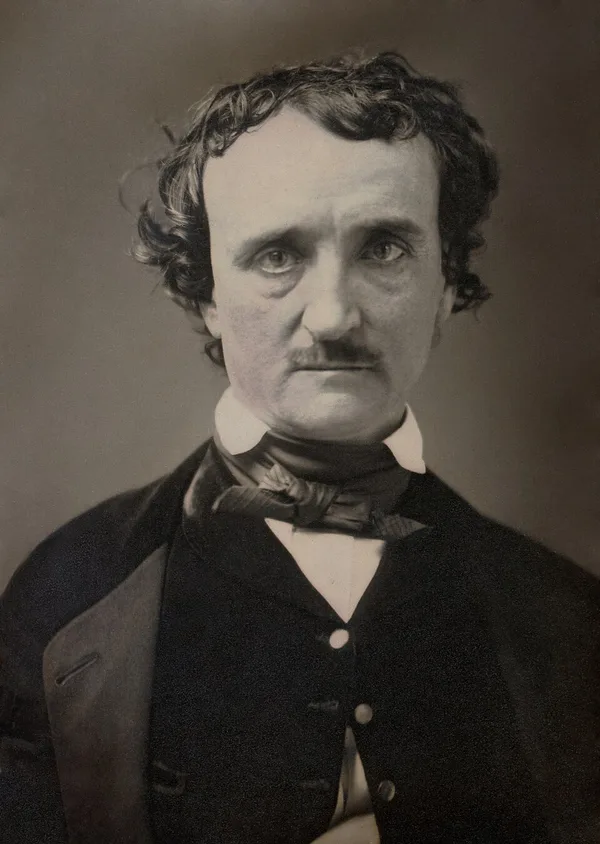
Elizabeth is presented as a fragmentary poem attributed to Edgar Allan Poe. The text blends archaic diction with modern commentary, creating a layered voice that oscillates between reverence for classical tradition and an ironic critique of poetic conventions.
Form & Structure
- Stanzaic pattern: The poem is divided into two apparent stanzas, each separated by a line of bracketed commentary. This interjection technique is reminiscent of Poe’s own use of footnotes and marginalia in works such as The Raven.
- Meter: The lines do not follow a strict metrical scheme. Instead, they exhibit a free verse quality that mirrors the thematic emphasis on “contradiction” and the breaking of poetic rules.
- Rhyme: No consistent rhyme scheme is evident. The occasional rhymes feel incidental, reinforcing the poem’s intent to subvert expectations.
Language & Diction
The poem juxtaposes archaic and contemporary diction: “thy own book,” “muses thro’ their bowers,” and “heathenish Greek name” contrast with modern phrases like “my innate love of contradiction.” This creates a sense of temporal dislocation, a hallmark of Poe’s fascination with the uncanny.
Theme & Motifs
- Authority of the poet: The speaker claims to have “other reasons” for writing, hinting at an underlying critique of the poet’s role as a moral or intellectual authority.
- Contradiction & irony: The poem explicitly embraces contradiction, suggesting that the act of writing itself is paradoxical.
- Tradition vs. Innovation: By invoking “Zeno and other sages” while simultaneously dismissing conventional rules, the poem positions itself as a bridge between classical reverence and modern experimentation.
Use of Parenthetical Commentary
The bracketed lines serve as meta-commentary, providing an editorial voice that comments on the poem’s own logic. This device invites readers to question the reliability of narrative and blurs the boundary between text and author.
Possible Interpretations
- Poe’s self‑reflection: The poem could be a satirical take on Poe’s own preoccupation with form and meaning, exposing the tension between his love for structure and his desire to break it.
- Critique of literary authority: By labeling the poet as “a fool” and dismissing “one important rule,” the poem challenges traditional hierarchies in literature.
- Philosophical inquiry: The reference to “Zeno” and the Greek name hints at paradoxes and epistemological questions, suggesting that truth is elusive.
Conclusion
“Elizabeth” is a compact, self‑referential piece that exemplifies Poe’s fascination with paradox and form. Its fragmented structure, mixed diction, and meta‑commentary invite a layered reading that oscillates between homage to classical traditions and a critique of poetic conventions.
More poems by Edgar Allan Poe
People who read this also read
Picked for you from the reading habits of our literary commons.
Poem knowledge graph
A literary network built from the poet who wrote this poem and the words poems have in common.
Click a node to explore it; use the mouse wheel to zoom.