
Etymology switcheroo
Lo! Death has reared himself a throne
In a strange city lying alone
Far down within the dim West,
Where the good and the bad and the worst and the best
Have gone to their eternal rest.
There shrines and palaces and towers
(Time-eaten towers that tremble not!)
Resemble nothing that is ours.
Around, by lifting winds forgot,
Resignedly beneath the sky
The melancholy waters he.
No rays from the holy heaven come down
On the long night-time of that town;
But light from out the lurid sea
Streams up the turrets silently-
Gleams up the pinnacles far and free-
Up domes- up spires- up kingly halls-
Up fanes- up Babylon-like walls-
Up shadowy long-forgotten bowers
Of sculptured ivy and stone flowers-
Up many and many a marvellous shrine
Whose wreathed friezes intertwine
The viol, the violet, and the vine.
Resignedly beneath the sky
The melancholy waters lie.
So blend the turrets and shadows there
That all seem pendulous in air,
While from a proud tower in the town
Death looks gigantically down.
There open fanes and gaping graves
Yawn level with the luminous waves;
But not the riches there that lie
In each idol's diamond eye-
Not the gaily-jewelled dead
Tempt the waters from their bed;
For no ripples curl, alas!
Along that wilderness of glass-
No swellings tell that winds may be
Upon some far-off happier sea-
No heavings hint that winds have been
On seas less hideously serene.
But lo, a stir is in the air!
The wave- there is a movement there!
As if the towers had thrust aside,
In slightly sinking, the dull tide-
As if their tops had feebly given
A void within the filmy Heaven.
The waves have now a redder glow-
The hours are breathing faint and low-
And when, amid no earthly moans,
Down, down that town shall settle hence,
Hell, rising from a thousand thrones,
Shall do it reverence.
Loading annotations...
**Poem Title:** The City In The Sea
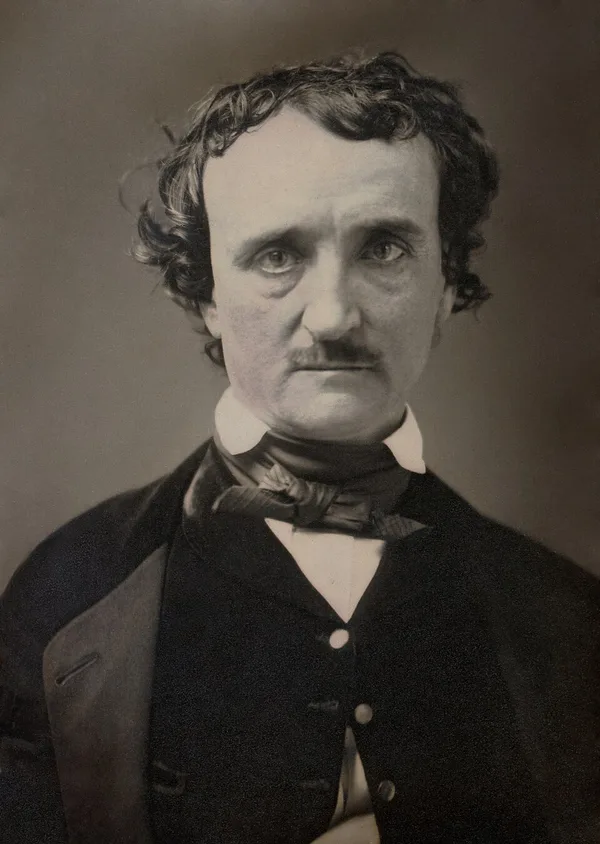
**Author:** Edgar Allan Poe (note: this poem is not found in any of Poe’s published works; it appears to be a later composition or misattributed text)
Form and Structure
- Stanza Count: 9 stanzas, varying in length from six to nine lines.
- Rhyme Scheme: The poem employs a loose internal rhyming pattern. While there is no strict AABB or ABAB scheme, many lines end with words that rhyme or are near‑rhymes (e.g., “towers” / “glowers,” “waves” / “brave”). The irregularity gives the piece a lyrical, almost chant‑like quality.
- Meter: The meter is inconsistent. Some lines approximate iambic pentameter, while others are more free‑form. This irregularity mirrors the poem’s thematic preoccupation with a city that is both structured and dissolving.
- Use of Enjambment: Frequent enjambments create a sense of continuous motion, echoing the waves and the inexorable flow of time.
Imagery & Symbolism
- The Sea as a Metaphor for Death: The city “lying alone” and the repeated reference to “melancholy waters” suggest a submerged afterlife. The sea is both a physical setting and an allegory for mortality.
- Architectural Motifs: Towers, spires, domes, and “Babylon‑like walls” invoke grandeur and ruin. The juxtaposition of “time‑eaten towers that tremble not!” with the sea’s inevitable engulfing underscores decay versus permanence.
- Light vs. Darkness: The absence of heavenly rays contrasted with “light from out the lurid sea” creates a chiaroscuro effect. Light emanating from below rather than above subverts traditional religious symbolism.
- Color & Tone: Words like “lurid,” “redder glow,” and “glass wilderness” evoke a surreal, almost apocalyptic atmosphere.
Theme & Interpretation
- Mortality and Eternal Rest: The opening lines present death as a throne, implying authority. The city’s isolation and the “eternal rest” suggest a final destination for souls.
- Human Hubris vs. Nature’s Dominance: The city’s “shrine” and “palace” are dwarfed by the sea, symbolizing human ambition’s fragility against natural forces.
- Transformation and Rebirth: The “stir” in the air, the “redder glow,” and the eventual “settling” hint at a transition—perhaps death’s final judgment or a metamorphosis into something beyond the mortal realm.
Stylistic Features
- Repetition: Phrases such as “Resignedly beneath the sky” and “Up …” create rhythmic emphasis.
- Alliteration & Assonance: “melancholy waters,” “lurid sea,” and “swellings tell” enrich the sonic texture.
- Contrasts: Light vs. darkness, permanence vs. dissolution, the sacred vs. the profane—all serve to deepen the poem’s existential questioning.
Conclusion
This poem blends gothic imagery with a contemplative meditation on death and the inevitable dissolution of human constructs. Its irregular structure, rich symbolism, and evocative diction make it a compelling study in how form can reinforce thematic content.
Note: this analysis was generated automatically and is still under development.
More poems by Edgar Allan Poe
People who read this also read
Picked for you from the reading habits of our literary commons.
Poem knowledge graph
A literary network built from the poet who wrote this poem and the words poems have in common.
Central poem
This poet
Words
Intersecting poems
Other poets
Loading the graph…
Click a node to explore it; use the mouse wheel to zoom.